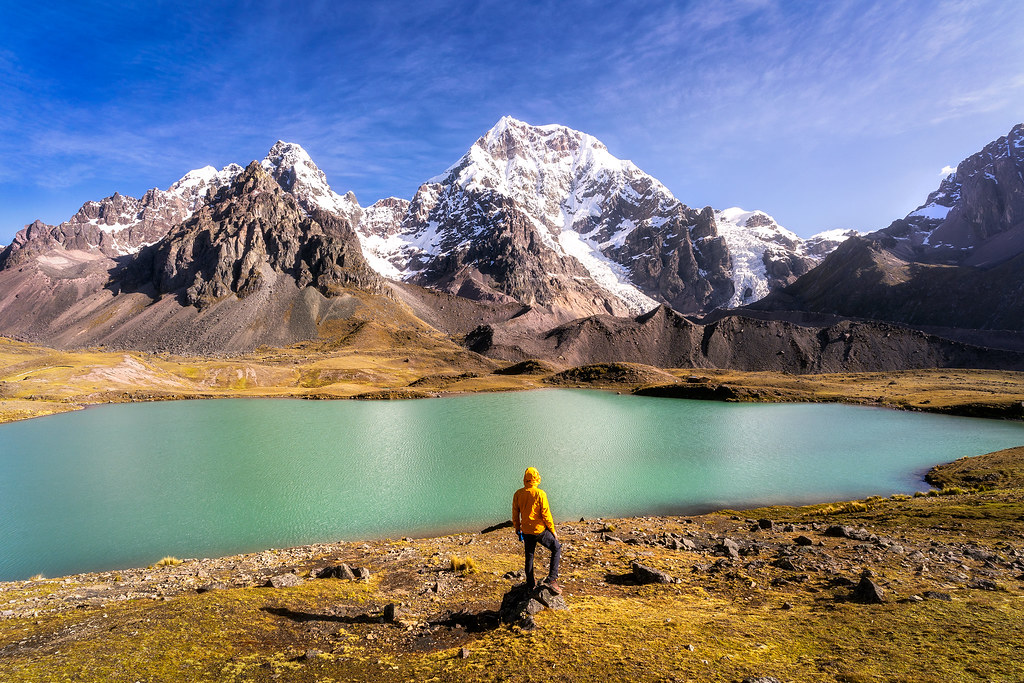

7 Lagoons are a hidden paradise in the heart of southern Peru, where the sky blends with the mountains and the pure air of the Andes seems to touch the soul. At the foot of the imposing Ausangate Mountain, one of the most majestic and sacred mountains in Cusco, lies this group of glacial lakes, dazzling with the intensity of their colors and the profound spiritual connection that emanates from their natural surroundings.
Each of these lagoons reflects not only the Andean landscape but also the ancestral energy that for centuries has inspired respect and admiration in the communities that inhabit these heights.
This destination, located in the province of Quispicanchi, within the district of Ocongate, a few hours from the city of Cusco, has become a place of pilgrimage for both trekking and photography enthusiasts and those seeking a profound experience, far from the urban noise and close to the spirit of the Andes.

Ausangate: Guardian of the Andes
The Apu Ausangate, at 6,384 meters above sea level, is considered the protective god of Cusco. For Andean communities, the Apus are sacred mountains that possess life, energy, and wisdom. In the Andean worldview, Ausangate represents strength, fertility, and the balance between humanity and nature.
Its imposing presence dominates the entire landscape of the region. At its feet, rivers rise, glaciers form, and plains covered with ichu (the Andean straw that feeds llamas and alpacas) extend. The water that descends from Ausangate gives rise to the seven lagoons, which in turn reflect their changing colors depending on the time of day and the position of the sun.

The Mystery of the Seven Colors
7 Lagoons of Ausangate are the result of the fusion of glacial ice with the minerals of the Andean soil.
Each lagoon has a particular hue: turquoise, emerald green, deep blue, or even reddish, depending on its mineral composition and the light.
Among the best known are:
-Oqecocha, with intense turquoise waters, surrounded by rock formations.
-Patacocha, with a crystalline green color that reflects the clouds.
-Alqacocha, with a deep blue hue that resembles a mirror of the sky.

-Qomercocha, bright green, prized for its serenity.
-Orqo Otorongo and China Otorongo, two twin lagoons of distinct blue hues, whose names allude to the “male and female jaguar.”
-Puka Cocha, reddish in color, whose name in Quechua means “red lagoon.”

These lagoons are scattered throughout a high-altitude area, and each one seems to have its own personality, as if they were silent guardians of the Ausangate. The reflections of the glacier on their waters and the contrast of colors create a magical, almost unreal atmosphere that leaves those who venture there speechless.
A Journey Through the Living Andes
The journey to the lagoons is an experience that goes beyond the physical. The road winds through snow-capped mountains, yellow grasslands, and small streams that flow down from the glaciers.
Along the way, it’s common to see herds of alpacas and llamas grazing freely, accompanied by local shepherds, who still wear their traditional colorful ponchos and wool hats.
The silence of the landscape is profound, interrupted only by the wind or the murmur of the water. On clear days, the sky is such a pure blue that it seems an extension of the lagoons themselves. The air is cold, but each step reveals a new perspective of Ausangate and the immensity that surrounds it.
The natural environment is also a refuge for various species of high Andean fauna. You can spot vicuñas, Andean foxes, vizcachas, and birds such as condors and huallatas, which fly over the valleys in search of food. This ecosystem, although fragile, maintains an ancient balance between ice, water, and life.

An Enduring Cultural Heritage
The Ausangate area is not only a place of natural beauty, but also a territory steeped in history and tradition. The Pacchanta and Tinki communities, who live on the mountain slopes, proudly preserve their ancestral customs. There, time seems to have stood still. Families continue to dedicate themselves to herding and textile crafts, using techniques passed down from generation to generation.
The alpaca and vicuña textiles made in this area are considered among the finest in Peru. Each garment tells a story: the embroidered symbols represent mountains, animals, and natural elements that hold profound spiritual significance.
Visitors can observe the entire process, from shearing the animal to dyeing with natural pigments and weaving on rustic looms.
In these communities, life revolves around Pachamama (Mother Earth). Every morning, before leaving for work, the community members offer coca leaves or small portions of chicha (a type of drink) as a way of thanking the earth for its fertility.
This spiritual connection with nature is one of the most valuable experiences a traveler can gain in Ausangate.

The Power of Qoyllur Riti
One of the most fascinating aspects of Ausangate is its connection to the Qoyllur Riti festival, one of the most important celebrations in the Andean calendar. Every year, before Corpus Christi, thousands of pilgrims come to the foothills of Ausangate to pay homage to a sacred image known as the “Lord of Qoyllur Riti,” which symbolizes the union of the Andean world and Christianity.
For several days, participants dance, sing, pray, and climb toward the glaciers to collect blocks of ice considered sacred. This ritual, which combines the Catholic faith with the indigenous worldview, has been recognized by UNESCO as an Intangible Cultural Heritage of Humanity.
Visiting 7 Lagoons during this time allows you to witness one of the most profound manifestations of Andean spirituality, where the music of drums and flutes resonates among the mountains and the ice seems to have a life of its own.

An Encounter with the Essential
The journey to 7 Lagoons of Ausangate is an invitation to introspection. It is not just a tourist destination, but a space where you can reconnect with nature and with yourself. The immensity of the landscape, the silence of the heights, and the energy of the Apu generate a sense of peace difficult to find elsewhere.
Visitors quickly understand that Ausangate is not just a snowy peak: it is a living presence that observes, protects, and teaches. Every lagoon, every rock, and every breath of wind seems to hold a message. At these heights, nature commands respect and humility.
Furthermore, contact with the local communities teaches a lesson about the harmony between humans and their environment, a relationship that has often been lost in the modern world.

A Transforming Destination
Traveling to 7 Lagoons of Ausangate is much more than a mountain hike. It’s an experience that awakens all the senses: the aroma of the ichu tree, the sound of the wind, the cool, pure air, the silence that invites reflection. Every step along these trails is a reminder that nature is powerful, generous, and sacred.
Visitors who come here not only take home photographs, but also a sense of respect and awe at the grandeur of the Andes. Ausangate, with its imposing beauty and spiritual energy, teaches an essential lesson: that true luxury lies in simplicity, in nature, in connection with the earth.
7 Lagoons of Ausangate are not just any destination. They are a natural sanctuary where the sky is reflected in the water, where the mountains speak silently, and where the traveler finds, perhaps without seeking it, a piece of themselves among the colors and heights of deep Peru.