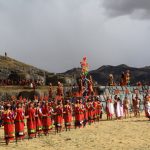

Inti Raymi in Cusco is one of the most impressive and significant celebrations in Peru and all of South America. Every June 24th, thousands of people gather in the capital of the ancient Tahuantinsuyu to witness the Festival of the Sun, a ritual that honors Inti, the god most venerated by the Incas.
This event is not simply a cultural spectacle. It is a transformative experience that connects past and present, tradition and modernity, spirituality and tourism. Inti Raymi is, without a doubt, the best opportunity to immerse yourself in the Andean worldview and understand the profound relationship this people maintain with nature and the stars.

History of Inti Raymi: The Legacy of Inca Pachacútec
The origin of Inti Raymi dates back to the 15th century, during the reign of Pachacútec Inca Yupanqui, considered the great reformer of the empire. He established the ceremony to pay homage to the Sun and ensure the agricultural cycle continued abundantly.
The Andean winter solstice marked the perfect time to perform this ritual, as it represented the hope of the return of the sun and the renewal of life. Inti Raymi was, therefore, an agricultural, political, and spiritual festival that united the entire empire.
During the Tahuantinsuyu era:
-The ceremony lasted nine full days.
-The four suyas (Chinchaysuyo, Antisuyo, Collasuyo, and Contisuyo) sent delegations with offerings.
-The Inca presided over the rituals dressed in a mascaypacha (royal crown) and a golden outfit that shone like the sun.
-Sacrifices of llamas and agricultural products were offered to Pachamama and Inti.
Inti Raymi symbolized the unity of the people and the legitimacy of the Inca’s power as son of the Sun.

Current Inti Raymi Venues
Today, the ceremony has been reborn as a cultural and tourist attraction that keeps the ancient tradition alive. It takes place in three key locations in Cusco, each steeped in symbolism:
🔹 Coricancha (Temple of the Sun)
The ritual begins at Coricancha, an ancient temple dedicated to Inti. With the first rays of the sun, the priests make offerings and begin the ceremony.
🔹 Plaza de Armas of Cusco
The Inca, accompanied by his wife, the Coya, appears before the people and delivers a speech in Quechua steeped in symbolism. It is a solemn moment that connects visitors with Andean spirituality.
🔹 Sacsayhuamán
The great esplanade of Sacsayhuamán is the central stage. Here, more than 700 actors recreate the ritual with music, dance, and offerings to the Sun. It is the highlight of Inti Raymi and the spectacle that attracts thousands of visitors from around the world.


Music, Dance, and Costume
Inti Raymi is an explosion of color, movement, and sound. Each element has a profound meaning:
-Music: drums, quenas, and pututos accompany the ceremonies, evoking the power of nature.
-Dances: the movements represent the fertility of the land, the harvests, and the union of peoples.
-Clothing: golden attire for the Inca, multicolored clothes for the dancers, feather crowns, and cloaks that reflect the cultural richness of the Tahuantinsuyu.
The parade is a visual journey into the past that makes the spectator feel part of the Inca empire.


The Symbolism of Inti Raymi
Beyond the spectacle, Inti Raymi has a profound message:
-The Sun (Inti): source of life and energy.
-The Inca: son of the Sun, intermediary between the divine and the human.
-Pachamama: Mother Earth, who receives the offerings.
-The sacred fire: symbol of renewal and continuity of life.
Every gesture, every dance, and every song has a spiritual meaning that reflects the Andean worldview: man does not dominate nature, but lives in harmony with it.


Tips for Enjoying Inti Raymi
Arrive early in Sacsayhuaman to get a good spot.
Bring water, sunscreen, and a hat, as the ceremony lasts several hours.
Learn about Quechua, the language in which the ceremony is held.
Make reservations in advance, especially for the official stands.
Explore Cusco in June, as the entire month is filled with celebrations.
The Month of June in Cusco: Beyond Inti Raymi
Inti Raymi is the main festival, but June in Cusco is a month full of celebrations that complement this unique experience:
-Corpus Christi: a religious procession with images of saints and virgins.
-Feast of San Juan: a popular celebration throughout Peru, especially in the jungle.
-Qoyllur Rit’i: a pilgrimage to Sinakara Mountain, where faith and nature unite.
Participating in these festivities will allow you to experience Cusco at its most culturally significant.
Frequently Asked Questions About Inti Raymi
When is Inti Raymi celebrated?
June 24th every year.
Where is it held?
At Coricancha, the Plaza de Armas, and Sacsayhuamán.
What language is the ceremony in?
In Quechua, with translations available.
How long does the performance last?
Approximately six hours.
Is it just a tourist spectacle?
No. Although it is a modern performance, it holds a deep spiritual value for Andean communities.
Final reflection: the light that never goes out
Inti Raymi in Cusco is not just a cultural event. It is a living testament to the greatness of the Tahuantinsuyu and the unbreakable connection that the Andean people maintain with nature and the universe.
Attending Inti Raymi is to feel how the Andes speak through its people. Every gesture, every dance, and every song in Quechua is a bridge between the past and the present, reminding us that time does not erase the roots of a people who learned to live in harmony with the sun, the earth, and the stars.
This celebration also invites us to reflect on our own relationship with nature. In a fast-paced world, where we often forget the importance of the essential, Inti Raymi teaches us that life has meaning when we are grateful, when we recognize the source of our existence, and when we respect the balance of the planet.
The Inca raising his arms toward the sun in Sacsayhuamán is not just a theatrical image: it’s a symbolic act that continues to move hearts. It reminds us that humankind is not above nature, but rather a part of it, and that without the sun, the earth, and water, we are nothing.
The Inti Raymi in Cusco is, ultimately, a mirror in which we can look into ourselves and discover how much of that ancestral spirit still lives within us. It is an invitation to reconnect with gratitude, spirituality, and community.
And as the golden rays of the sun illuminate the mountains of Cusco, the spirit of Inti Raymi will continue to shine not only in the Andes, but in every traveler who returns transformed by this unique experience.