
Corpus Christi in Cusco is one of the most striking celebrations on the Peruvian festive calendar. It is not just a religious rite, but an event that merges centuries of history, beliefs, and customs. Every year, forty days after Holy Week, the imperial city is transformed into a scene of faith, color, music, and flavor.
Declared a National Cultural Heritage Site, this festival brings together thousands of Cusco residents and visitors who gather in the Plaza de Armas and the Cathedral to witness the procession of saints and virgins. Through this celebration, Cusco reaffirms its unique identity: a blend of colonial Catholicism and the Andean spirituality that still beats in the heart of its mountains.

Origin and History of Corpus Christi in Cusco
Corpus Christi is a Catholic festival that originated in Europe in the 13th century to exalt the presence of Christ in the Eucharist. The Spanish introduced it to the Americas during the colonial period, and it acquired particular significance in Cusco.
In Inca Cusco, the winter solstice was celebrated with Inti Raymi, the most important ritual of the Tahuantinsuyu. To replace that practice, the Spanish promoted Corpus Christi. However, instead of erasing Andean traditions, what occurred was a cultural fusion: indigenous communities recognized the saints and virgins as protectors similar to their tutelary gods.
Thus was born a mestizo ritual that, more than 400 years later, continues to draw crowds and move both locals and foreigners.
The Great Procession of Saints and Virgins
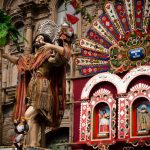
The most anticipated moment of Corpus Christi is the procession of fifteen sacred images, each from different parishes in Cusco and its surroundings. These images arrive at the Plaza de Armas accompanied by music, flowers, dancers, and faithful dressed in traditional costumes.
Some of the most representative images are:
-Lord of the Earthquakes: patron saint of Cusco and symbol of protection against natural disasters.
-Our Lady of the Nativity: venerated in the parish of Almudena.
-Saints Sebastian and Christopher: protectors of Cusco’s traditional neighborhoods.
-Saint Blaise: patron saint of Cusco artisans.
-Saints Anthony and Jerome: saints associated with farming communities.
-Our Lady of the Immaculate Conception: known as “La Linda” (The Beautiful One) for the devotion she inspires.
-Saints Peter and Paul: symbols of the universal Church.


The images, beautifully decorated with cloaks, jewels, and flowers, are carried on floats by faithful devotees. During the procession, each saint seems to compete in majesty with the others, showcasing the artistic richness and deep faith of each Cusco neighborhood.
Corpus Christi as a Cultural Spectacle
Although its origins are religious, Corpus Christi is also experienced as a great popular festival. In the streets, the music of traditional bands, fireworks, and parades fill the city with joy.
The marching bands accompany each image with solemn marches, huaynos, and Cusco melodies.
Traditional dances represent the identity of each community and showcase the cultural richness of Cusco.
The attire is a display of color: cloaks, hats, embroidered outfits, and feather ornaments mingle with the festive attire of the devotees.
Corpus Christi is also a space for social gathering: entire families, national and foreign visitors, come together in an atmosphere of respect, devotion, and collective celebration.
Corpus Christi Cuisine: Chiriuchu
No Corpus Christi celebration is complete without chiriuchu, the holiday’s emblematic dish. Its name in Quechua means “cold chili” or “cold spicy,” and its origin dates back to the colonial era.
The most fascinating thing about chiriuchu is that it combines ingredients from all three regions of Peru, reflecting the country’s diversity:
-From the Andes: roasted guinea pig, chicken, and toasted corn.
-From the coast: dried seaweed and fish roe.
-From the jungle: chorizo and chili peppers that add flavor and color.
-From Cusco itself: fresh cheese and French toast.
The dish is served cold and always accompanied by chicha de jora or Cusco beer. In the streets, dozens of stalls offer chiriuchu on large decorated platters, turning the city into a gastronomic festival.

The Symbolism of Corpus Christi
Every detail of this celebration has a meaning:
The saints and virgins represent the protection of each community and neighborhood.
The Cusco Cathedral is the space where devotion and the encounter between the sacred and the popular are concentrated.
The chiriuchu is the embodiment of cultural and gastronomic fusion.
The procession is a symbol of unity: all the parishes come together in a single space.
Corpus Christi, more than a celebration, is a reminder that faith and culture can walk together, strengthening the identity of a nation.
Tips for Experiencing Corpus Christi in Cusco
Arrive early at the Plaza de Armas to secure a good spot overlooking the procession.
Try chiriuchu at the traditional stalls, but bring cash, as many don’t accept cards.
Respect the devotion of the faithful: don’t interrupt the processions with intrusive photographs.
Wrap up warm, because Cusco’s nights are cold in June.
Enjoy the festive atmosphere in the streets: music, dances, fairs, and food will be everywhere.

Corpus Christi within Cusco’s festive calendar
Corpus Christi is part of a month full of celebrations in Cusco:
June is considered the “jubilee month of Cusco.”
Inti Raymi (June 24) coincides with this festive season.
Corpus Christi is complemented by other religious and cultural celebrations that make Cusco, literally, a city of celebration throughout the month.
Frequently asked questions about Corpus Christi in Cusco
When is Corpus Christi celebrated in Cusco?
Forty days after Easter Sunday.
How many images participate?
Fifteen saints and virgins from different parishes.
Where does the main procession take place?
In Cusco’s Plaza de Armas and the Cathedral.
What typical dish is eaten during this celebration?
Chiriuchu, a cold dish that combines products from the coast, mountains, and jungle.
Is it recommended for foreign tourists?
Yes. It is one of the best opportunities to experience Cusco’s spirituality and culture in all its dimensions.
Final reflection: a celebration that unites worlds
Corpus Christi in Cusco is more than a holiday: it is a bridge between the past and the present, between the sacred and the festive, between the Catholic faith and the Andean worldview.
Every saint that parades, every virgin that crosses the Plaza de Armas, every dance and every musical note are testimonies to the cultural resilience of a people who have managed to keep their roots alive in the midst of modernity.
Chiriuchu, with its ingredients from the coast, mountains, and jungle, is a reminder that diversity is our greatest wealth. Just as this dish unites flavors, Corpus Christi unites communities, generations, and cultures in a single act of celebration.
For the people of Cusco, it is a moment of gratitude. For visitors, it is an opportunity for wonder and learning. And for all, it is an invitation to look at life with greater respect, devotion, and love for what we share as humanity.
Corpus Christi is, in essence, a lesson that transcends borders: it teaches us that faith has no single language, that culture is renewed when it is shared, and that, as long as there is music, dance, and grateful hearts, the light of Cusco will continue to illuminate the entire world.