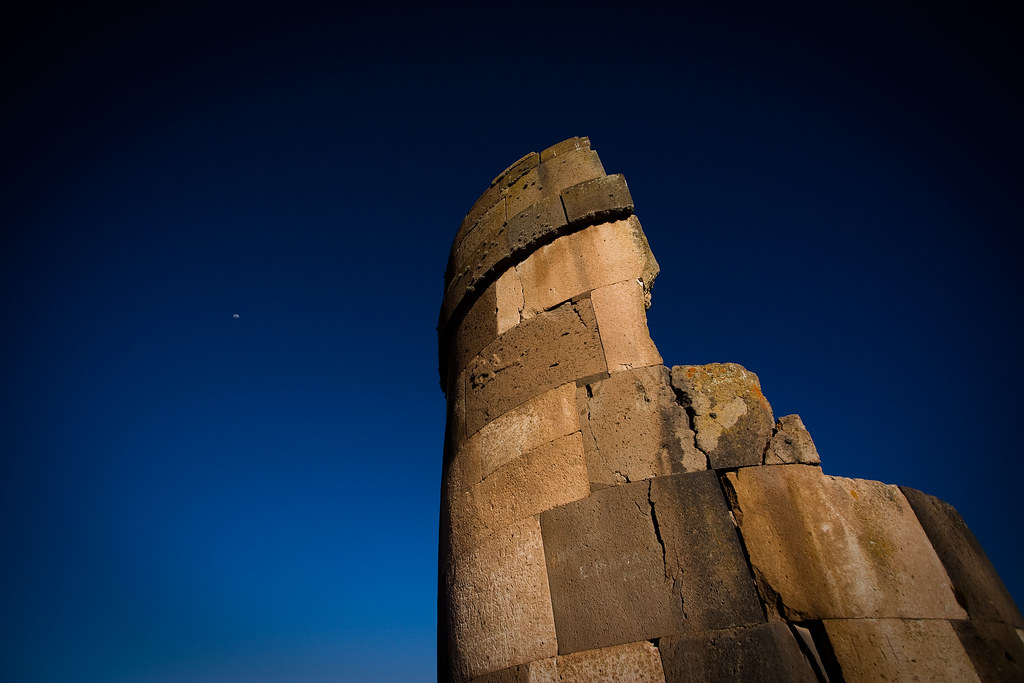

Chullpas of Sillustani rise on the Peruvian altiplano, a few kilometers from the city of Puno, as one of the country’s most impressive and mysterious archaeological sites.
This complex of funerary towers dominates the landscape from a peninsula surrounded by Lake Umayo, creating an awe-inspiring vista that blends ancient architecture with the natural serenity of the Andes.
The name “Sillustani” comes from the Aymara language and means “shore of the snails.”
This site was used as a necropolis by the Colla culture before the expansion of the Inca Empire, and later adapted by the Incas themselves.
Today, the chullpas remain a symbol of the profound respect that Andean civilizations held for death, the cosmos, and the continuity of life.
What are the Chullpas of Sillustani?
Chullpas are stone funerary towers built by the pre-Incan peoples of the Andean highlands, primarily the Colla culture. These structures served as collective tombs for the most important members of society: rulers, priests, and warriors.
Each tower functioned as a family mausoleum, where mummies were placed in a fetal position along with valuables, ceramics, textiles, and offerings.
The architecture of the Sillustani Chullpas is unique in the Andean world. Although chullpas exist at other sites on the Collao Plateau, none possess the magnificence, size, and state of preservation of those at Sillustani.
The tallest exceed 12 meters in height and were constructed with perfectly carved and fitted stones, often without the use of mortar.

Architecture and Symbolism of the Chullpas of Sillustani
The Chullpas of Sillustani reveal a mastery of engineering and symbolism.
They are made with blocks of volcanic stone, precisely carved to fit together without gaps. Some display a construction technique so advanced that it rivals the most famous Inca structures, such as Sacsayhuaman or Machu Picchu.
The Chullpas of Sillustani have a cylindrical or truncated conical shape, wider at the top than at the base, giving them a monumental and elegant appearance.
Each tower features a small opening facing east, through which the mummified bodies were placed. This orientation was not accidental: east represents the rebirth of the sun, a symbol of life and renewal.
For Andean cultures, death was not an end but the beginning of a new cycle, and the Sun, Inti, guided this sacred journey to the afterlife.
Some of the Chullpas of Sillustani display exquisite bas-relief carvings with figures of snakes, lizards, or felines animals considered sacred in the Andean world.
These symbols represented power, wisdom, and spiritual protection.

The Colla Culture and Its Legacy
The Chullpas of Sillustani are one of the main legacies of the Colla culture, an Aymara people who inhabited the Andean highlands before the arrival of the Incas.
The Collas were expert builders and herders, with a deep understanding of the land and natural cycles.
Their society was organized hierarchically, and burials reflected the status of each individual.
The bodies were mummified and placed in a fetal position inside the chullpas, accompanied by offerings that ensured their passage to the spiritual world.
This ancestor worship reveals a worldview based on the duality and balance between life, death, and nature.
With the expansion of the Inca Empire in the 15th century, the Incas adopted many elements of the Colla culture, including their funerary practices.
In Sillustani, one can admire Inca-style chullpas, built with perfectly polished stones, unlike the more rustic ones of Colla origin. This architectural blend demonstrates how Andean civilizations influenced one another.
Lake Umayo: Mirror of the Gods
The natural setting of the Sillustani Chullpas is as breathtaking as the structures themselves.
The archaeological site rises on a peninsula jutting into Lake Umayo, a body of water that reflects the surrounding mountains, creating a landscape of serenity and mysticism.
For Andean cultures, lakes were sacred portals to the spiritual world. Lake Umayo symbolized the link between earth and sky, between the living and the dead.
Its name, of Aymara origin, means “place of the soul” or “sacred water,” reinforcing its symbolic importance.
The combination of the lake with the funerary towers makes Sillustani a place charged with energy, where the silence and the wind seem to hold the secrets of thousands of years of history.
Even today, many visitors and scholars believe that this place radiates a powerful spiritual energy, linked to the ancestral memory of the Andes.

Spirituality and Andean Cosmovision
The Chullpas of Sillustani were not simply tombs, but ritual spaces. Ceremonies were performed there to honor the ancestors, ask for fertility for the land, and ensure the prosperity of the people.
In the Andean cosmovision, the ancestors did not disappear: they remained present, watching over their descendants from the afterlife.
Each tower represented a link between the three Andean worlds:
-Hanan Pacha : (the upper world, of the gods and the stars)
-Kay Pacha : (the earthly world, where humans live)
-Ukhu Pacha : (the underworld, of the dead and the seeds)
The chullpas were, therefore, a symbolic gateway that united these three realms. Their vertical form evoked the ascent of the spirit to the heavens and the return of the soul to earth, in an eternal cycle.
This profound spiritual sense remains alive among the communities of the highlands, who preserve ancestral customs linked to Pachamama (Mother Earth) and the apus (spirits of the mountains).

Construction Techniques and Andean Perfection
The engineering behind the Chullpas of Sillustani continues to amaze modern archaeologists.
The stones were carved with millimeter precision, without cement or known metal tools.
It is believed that the builders used volcanic stones, transported from nearby quarries, and that they applied polygonal interlocking techniques, similar to those later mastered by the Incas.
Some towers display blocks weighing several tons perfectly aligned.
This construction perfection has led to comparisons with the pyramids of Egypt or the ruins of Tiwanaku in Bolivia.
Furthermore, the largest chullpas exhibit impressive detail: the exterior stones are finer and more regular, while those on the interior are rougher, demonstrating an advanced understanding of structural balance and aesthetics.
Sillustani in the Archaeological Context of Peru
The Sillustani archaeological complex is considered one of the most important necropolises in South America.
Its value lies not only in the monumental scale of its towers but also in its role within pre-Inca and Inca history.
It forms part of an archaeological circuit that connects the Andean cultures of southern Peru and the Bolivian highlands, evidencing centuries of interaction and cultural development.
Unlike other Peruvian archaeological sites focused on temples or cities, Sillustani offers a different perspective: the Andean peoples’ vision of the afterlife.
Therefore, more than a cemetery, this place is a testament to the spiritual thought that shaped an entire civilization.

An Eternal Legacy Facing Lake Umayo
Today, the chullpas of Sillustani stand as an imposing testament to the grandeur of the peoples who inhabited the highlands. Its silence speaks of respect, its stone of wisdom, and its surroundings of a connection to the divine.
The landscape, with Lake Umayo reflecting the towers beneath the blue sky of the high plateau, offers one of the most memorable scenes in southern Peru.
Sillustani is not only an archaeological site, but a symbol of the Andean soul, where death becomes continuity and stone an eternal word.
Each of its towers holds not only human remains, but also the living memory of a people who learned to commune with time, the earth, and the universe.