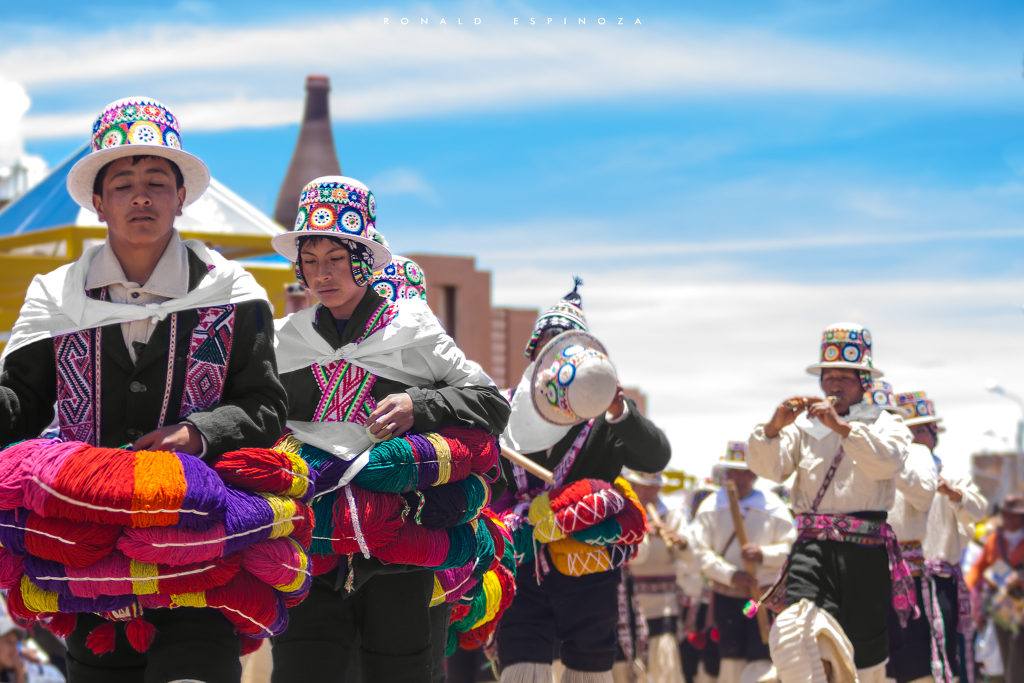

Festivity of the Virgin of Candelaria in Puno, Peru, is one of the most important religious and cultural celebrations in Latin America. Declared Intangible Cultural Heritage of Humanity by UNESCO in 2014 , this festival combines Catholic devotion with ancestral Andean roots in an impressive spectacle of music, dance, color and faith that attracts thousands of visitors each year.

Origin and meaning of the festival
The celebration in honor of the Virgin of Candelaria, patron saint of Puno, has its roots in colonial times, when the Spanish introduced Marian devotion to the region. However, the Andean faith merged with this tradition, giving rise to a mestizo festival that reflects the fusion of Christianity with pre-Hispanic rituals dedicated to Mother Earth (Pachamama).
According to local history, during the 17th century the inhabitants of Puno asked for the protection of the Virgin against an invasion by neighboring towns. Since then, the image of the Virgin of La Candelaria is considered the protector of the Puno people , a symbol of hope and spiritual union.
The name “Candelaria” comes from the candela or candle, which symbolizes the light of Christ and purification. In the Andean worldview, this light also represents the sacred fire of the sun, source of life and energy.

When is the Virgin of Candelaria celebrated?
The festival is celebrated every year in February , coinciding with the beginning of the Andean agricultural calendar and the rains that fertilize the land. The activities extend for more than two weeks , the central days being between February 2 and 15.
During this time, the city of Puno transforms into a great cultural scene where religion, art, music and dance are intertwined.
-Dances: soul and energy of the party
One of the most impressive aspects of the Festival of the Virgin of Candelaria are its traditional dances , considered true expressions of cultural identity.
More than 40,000 dancers and 9,000 musicians participate, organized in troupes that represent different provinces of the high plateau. There are two main types of dances:
1.Native or native dances
They are danced in the first days of the festival and represent the customs of the Quechua and Aymara peoples. Among the best known are:
-La Sicuris de Taquile , with pan flutes and drums.
-La Waca Waca , which parodies old bullfights.
-The Caporales , which symbolize strength and resistance.
These dances are an offering to the Virgin, but also a manifestation of the people’s bond with nature and their ancestral gods.

2. Dances of light costumes
They are presented during the octava (second week) and combine religious and carnival elements. They stand out:
–La Diablada puneña , one of the most famous, which represents the fight between good and evil.
-La Morenada , inspired by the history of African slaves in colonial mines.
-La Tinku, la Llamerada, la Rey Morena and many others, who fill the streets with glitter, sequins and masks.
Each troupe rehearses for months to participate in the contests and parades, which are carried out with impressive devotion.

The procession and religious acts
The spiritual part of the festival begins on February 2, the day of the Virgin of Candelaria. That day a solemn mass is celebrated in the Sanctuary of San Juan Bautista, where the sacred image is located.
Then, the Virgin is taken out in a procession through the streets of Puno, accompanied by thousands of faithful, lit candles, prayers and songs. The devotion is so deep that many believers make promises or walk barefoot as a sign of faith and gratitude.
During the following days, different religious activities are carried out:
-Rosaries, masses and novenas in honor of the Virgin.
-Night processions with torches and dances.
-Blessing of seeds and agricultural tools , in connection with the Andean agricultural calendar.

Contests, parades and living culture
In addition to its religious significance, the Candlemas Festival is a great cultural festival. The Native Dance Competition takes place at the Enrique Torres Belón Stadium , where groups compete showing their traditional clothing, choreography and melodies.
Subsequently, the troupes parade through the main streets of Puno on a route of several kilometers, followed by a crowd of local spectators and tourists. The entire city vibrates to the rhythm of drums, charangos, zampoñas and rattles.
Every year, the festival generates an important economic and tourist mobilization : hotels, restaurants and travel agencies prepare to receive thousands of national and foreign visitors.
Cultural and spiritual significance of the festival of the Virgin of Candelaria
The Virgin of Candelaria symbolizes the unity between the Andean and Christian worlds. Its festival is an example of how faith can coexist with ancestral traditions, without losing the essence of each culture.
For the people of Puno, the Virgin not only represents the protective mother, but also the strength of the earth, fertility and the energy that renews life. Therefore, every dance, every song and every step has a spiritual value.
The festival is, in essence, an expression of Andean identity that transcends borders. Beyond devotion, Candlemas is an opportunity to reaffirm the cultural pride of Puno and Peru before the world.
Tips to enjoy the Festival of the Virgin of Candelaria
1. Book in advance: Hotels and tours fill up months in advance.
2. Acclimatize to the altitude: Puno is located at more than 3,800 meters; drink coca or muña infusions.
3. Bring a coat and sunscreen: The weather is cold at night and sunny during the day.
4. Respect local traditions: Avoid interrupting processions or entering sacred areas without permission.
5. Actively participate: Dance, sing and enjoy, but always with respect for the devotion of the participants.
Conclusion: a party that beats to the rhythm of the Andean soul
The Festival of the Virgin of Candelaria is much more than a religious celebration: it is the cultural heart of the Peruvian highlands, where faith, dance and the living history of a people proud of their roots come together.
Attending this party is living a unique experience, full of color, music and spirituality, which leaves a mark on the soul of every traveler. If you dream of getting to know Peru that is deep, authentic and full of ancestral energy, Puno and its Virgen de la Candelaria await you with open arms.