
Arequipa is not a city that reveals itself immediately. It does not rely on spectacle, noise or excess to capture attention. Instead, it unfolds gradually, through atmosphere rather than attraction, through texture rather than display. It is a city that asks the traveler to slow down, to observe, and above all, to listen.
Known as The White City, Arequipa stands apart from many urban centers in South America. Its elegance is understated. Its beauty is structural. Its identity is firm, confident and unapologetically its own. This is not a city that tries to impress; it is a city that endures.
Situated between the arid Pacific coast and the vast Andean highlands, Arequipa occupies a position of transition — geographically, historically and culturally. That position has shaped a place of balance and tension, where restraint and intensity coexist. Over centuries, this balance has given rise to a city with remarkable coherence, depth and permanence.

Summary
A City Built from the Earth Itself
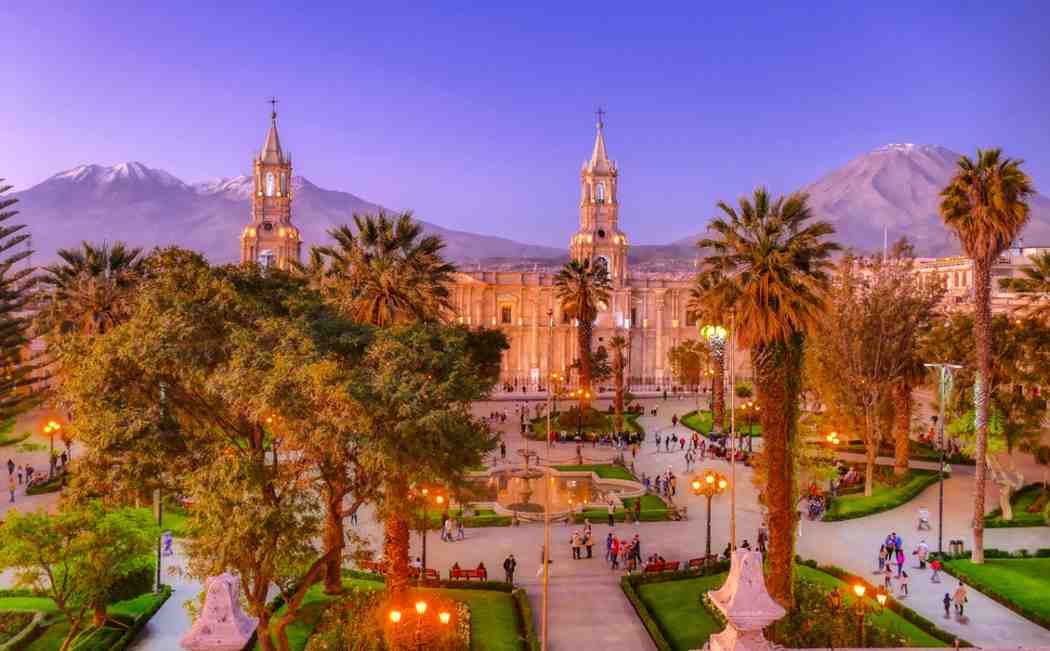
The defining feature of Arequipa is its relationship with stone. The city is constructed almost entirely from sillar, a white volcanic stone formed by ancient eruptions that reshaped the surrounding landscape. This material is not simply a building element; it is the physical expression of Arequipa’s identity.
Sillar gives the city its luminous appearance, but it also gives it unity. Churches, monasteries, civic buildings, private homes and walls speak the same architectural language. There is continuity in form, texture and tone. Walking through the historic center feels like moving through a single, carefully composed work rather than a collection of unrelated structures.
Light transforms the city throughout the day. In the morning, the stone reflects a soft clarity. At noon, it shines with intensity. By evening, it absorbs warm tones, turning streets and façades into quiet monuments. This constant dialogue between stone and light gives Arequipa a living presence.
Declared a UNESCO World Heritage Site, the historic center is remarkable not only for its preservation, but for its vitality. It is not frozen in time. People live, work and move within these spaces, allowing history to remain functional rather than ornamental.

The Silent Authority of the Volcanoes
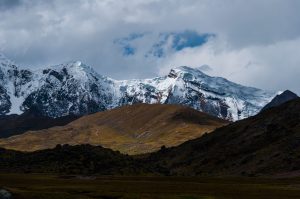
Arequipa exists under the constant gaze of volcanoes. Misti, Chachani and Pichu Pichu rise above the city, shaping both its skyline and its consciousness. Among them, Misti stands as the most emblematic — a perfectly formed cone that dominates the horizon with quiet power.
These volcanoes are not distant backdrops. They are omnipresent. They influence how the city feels, how it breathes, how it understands itself. Their presence instills humility and awareness, reminding inhabitants of forces older and greater than human design.
Rather than resisting these natural giants, Arequipa has learned to coexist with them. The city’s architecture, urban planning and materials reflect adaptation rather than defiance. Even the stone used to build the city comes from volcanic origin, reinforcing the idea that Arequipa is not placed upon the land — it emerges from it.
This coexistence creates a distinctive energy. The city feels grounded, stable and self-contained, as if anchored by the mountains that surround it.

Colonial Roots, Reinterpreted
Arequipa played a significant role during the colonial period, serving as an important administrative and religious center. Its churches, convents and monasteries reflect Spanish influence, yet they differ from colonial architecture found elsewhere in Peru.
Here, ornamentation is restrained. Proportion and symmetry take precedence over excess. The result is an architectural style that feels sober, refined and enduring. European forms were adapted to local materials, climate and seismic realities, producing a unique expression of colonial design.
This reinterpretation reflects a broader characteristic of Arequipa: the ability to absorb external influences without losing its core identity. The city does not imitate; it transforms.
A Tradition of Thought and Dissent
Beyond its physical beauty, Arequipa is known for its intellectual and political legacy. It has long been a city of strong opinions, civic engagement and critical thought. Writers, jurists, philosophers and political leaders have emerged from its streets, contributing to national debates and cultural movements.
This tradition of reflection and dissent remains part of the city’s character. There is a sense that ideas matter here, that history is something to be questioned and understood rather than passively accepted.
Arequipa thinks about itself — its past, its role and its responsibilities.
Identity Lived, Not Performed
Few regions in Peru possess such a deeply rooted sense of identity. In Arequipa, this identity is not displayed for visitors; it is simply lived. Pride in local history, customs and values is woven into daily routines.
Neighborhoods retain their character. Family structures remain strong. Traditions are passed down naturally, without staging or spectacle. This continuity creates an atmosphere of authenticity that is increasingly rare.
For travelers, this means encountering a culture that does not adapt itself for consumption. Arequipa does not seek approval; it remains itself.
The Rhythm of the City
Life in Arequipa moves deliberately. Streets are wide, plazas open, and public spaces invite stillness rather than urgency. The city encourages walking, observing and pausing.
Time feels different here. There is less pressure to move quickly, to complete checklists, to rush from one place to another. Instead, the city offers space — physical and mental — to exist within it.
This rhythm allows for deeper engagement. Details become visible. Patterns emerge. The city reveals itself through repetition rather than surprise.
A City in Dialogue with Its Landscape
Arequipa maintains a constant relationship with its surroundings. Mountains frame its limits. Valleys extend beyond its edges. The Andes are always present, visually and symbolically.
Urban life does not feel detached from nature. Instead, it feels integrated. The environment is not something separate from daily existence; it is an active presence that shapes perception and behavior.
This integration gives Arequipa a sense of balance rarely found in large cities.
Resistance to Homogenization
In an era where many destinations reshape themselves to fit global trends, Arequipa remains resistant. It does not chase novelty. It does not dilute its character to appeal to mass tourism.
Its strength lies in continuity and coherence. The city understands its value and protects it.
This resistance makes Arequipa especially compelling for those who seek depth rather than distraction. It offers substance instead of spectacle.
Memory That Endures
Some places are remembered through images. Arequipa is remembered through sensation. The coolness of stone beneath the hand. The silence of early mornings. The steady presence of volcanoes. The calm confidence of its streets.
Arequipa does not demand admiration.
It does not insist on attention.
It stays — quietly, firmly, unmistakably.