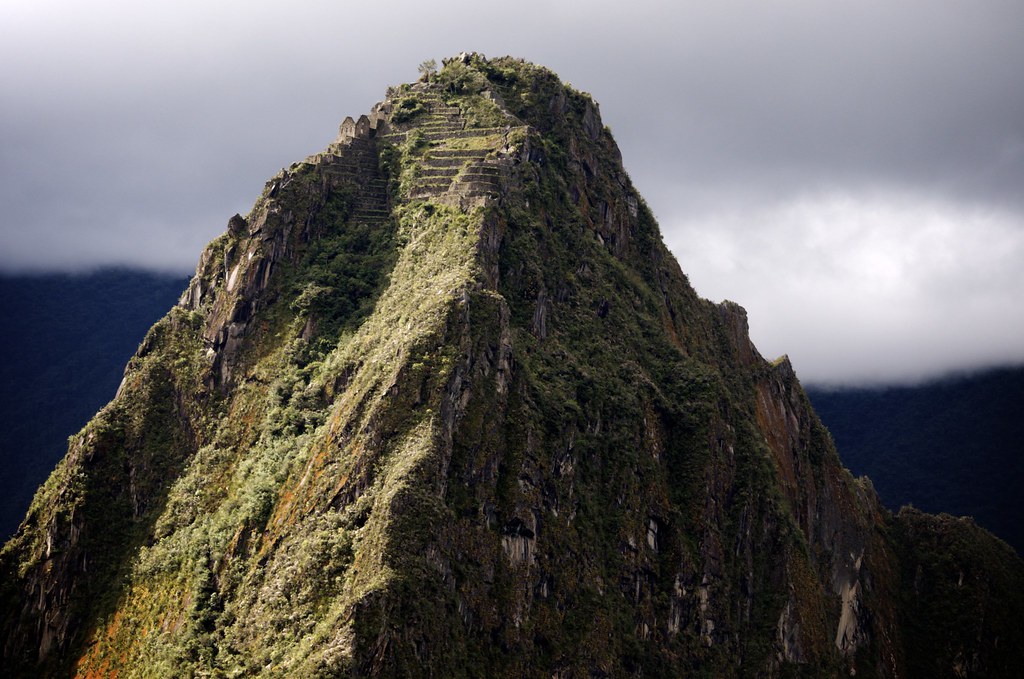

Huayna Picchu is not defined by its height alone. It is defined by the way it interrupts certainty. Rising sharply behind Machu Picchu, it reshapes the landscape not only physically, but conceptually. It is a mountain that refuses neutrality. To face it is to make a choice — to engage fully, or to step away.
This is not a destination designed for comfort, explanation, or passive admiration. Huayna Picchu exists as a threshold between observation and participation, between seeing and committing.

Summary
A Mountain That Does Not Welcome Everyone
Unlike many sacred places, Huayna Picchu does not soften its presence. There is no ceremonial entrance, no gradual introduction. From the first glance, its slopes communicate difficulty. The mountain makes no effort to be accessible.
This is deliberate.
Huayna Picchu was never meant to be inclusive in the modern sense. It was selective by nature. Only those willing to climb, to struggle, and to accept exposure were meant to reach its upper spaces. The mountain itself functions as a filter.
Access is earned, not granted.
The Body as the First Instrument of Understanding
Huayna Picchu cannot be understood intellectually before it is understood physically. The body is the first language here. Legs burn. Lungs adjust. Balance becomes intentional. Each step is negotiated rather than assumed.
This physical demand is not incidental. It aligns with an Andean worldview in which knowledge is embodied. Understanding comes through effort, repetition, and adaptation — not through distance or abstraction.
The mountain teaches through strain.
Paths That Reject Excess
The trail is narrow, steep, and unembellished. Stone steps are functional, not decorative. There are no unnecessary elements, no indulgence in symmetry or comfort. Everything exists because it must.
This restraint reflects a philosophy of efficiency without excess. The Incas did not build paths to impress. They built them to endure, to serve purpose, and to respect the terrain’s limits.
Huayna Picchu reveals a civilization fluent in restraint.
Exposure as Awareness
At certain points, the mountain opens abruptly. The drop becomes visible. The margin for error narrows. Fear appears — not as panic, but as clarity.
This exposure sharpens perception. Movements slow. Thoughts simplify. The mind stops wandering and returns fully to the present moment.
Huayna Picchu does not eliminate fear.
It refines it.
Height That Reorders Meaning
As the ascent continues, Machu Picchu below begins to transform. What felt immense from within becomes structured from above. The city’s logic emerges — terraces align, walls connect, spatial intention becomes legible.
This shift is crucial.
Huayna Picchu does not offer superiority. It offers perspective. It allows the observer to step outside immersion and see the system as a whole. The city is no longer just experienced — it is understood.
Height becomes comprehension.
Architecture That Listens to the Mountain
At the summit, the absence of monumentality is striking. There is no dominating structure, no declaration of power. Instead, small platforms, carved stones, and subtle integrations appear — almost as if they were always part of the mountain.
This architecture does not compete with nature. It negotiates with it.
Huayna Picchu is not an act of conquest. It is an act of alignment.

Silence as a Designed Experience
Sound behaves differently on Huayna Picchu. Voices fade quickly. Wind replaces language. Silence becomes heavy, deliberate, and unavoidable.
This silence is not empty. It creates mental space. Without constant stimulus, thought slows. Reflection deepens. The mountain does not distract — it concentrates.
Silence here is not the absence of noise.
It is the presence of focus.
Isolation and the Individual
Unlike the social spaces of Machu Picchu, Huayna Picchu isolates. The path separates travelers. Groups fragment. Each person moves at their own pace, facing their own hesitation and resolve.
This isolation removes performance. There is no audience. No validation. Only the relationship between body, terrain, and intention.
Huayna Picchu strips experience down to the individual.

Risk as Meaning, Not Flaw
Modern perspectives often frame risk as something to be eliminated. Huayna Picchu rejects this logic. Risk is not an accident here — it is structural.
The exposure, the narrow paths, the absence of excessive safeguards all contribute to the mountain’s meaning. Without risk, the ascent would lose its weight. Without consequence, effort would become meaningless.
Huayna Picchu teaches that value increases when something is at stake.
Time Slows by Necessity
On Huayna Picchu, speed is not rewarded. Rushing destabilizes balance. Carelessness amplifies danger. The mountain enforces slowness.
This enforced pace creates an unfamiliar rhythm. Time stretches. Moments become deliberate. Attention replaces urgency.
In resisting speed, Huayna Picchu preserves depth.
Beyond Achievement
Reaching the summit is not the climax. There is no triumphant moment scripted into the experience. Instead, there is stillness. Space. A quiet realization that the ascent itself carried more weight than the destination.
Achievement dissolves into awareness.
Huayna Picchu does not celebrate success.
It reveals process.
A Place That Cannot Be Reduced
Huayna Picchu resists consumption. It does not translate easily into images or summaries. Photographs flatten its verticality. Words struggle to capture its tension.
This resistance protects its integrity.
The mountain remains meaningful because it refuses simplification.
Discipline Over Display
Nothing on Huayna Picchu seeks attention. There is no spectacle. No exaggeration. The Incas did not build here to demonstrate power, but to express discipline — controlled effort applied with precision and restraint.
This discipline is its true legacy.
Huayna Picchu stands as evidence that greatness does not require excess.
Memory That Lives in the Body
Long after the descent, Huayna Picchu remains present — not as an image, but as a sensation. The memory of effort, balance, and focused movement lingers physically.
This is not a place remembered visually.
It is remembered somatically.
Huayna Picchu as a Choice Made Visible
Every step on Huayna Picchu reflects a decision: to continue, to slow down, to trust, to adjust. The mountain externalizes intention. It makes commitment visible through action.
There is no passive version of this experience.
Huayna Picchu exists for those willing to engage fully.

Not Above Machu Picchu, But Apart From It
Huayna Picchu does not overshadow Machu Picchu. It reframes it. It provides context without dominance, perspective without superiority.
Together, they form a dialogue: immersion and observation, community and solitude, horizontality and verticality.
Huayna Picchu completes the conversation.
Huayna Picchu: Where Meaning Requires Effort
In a world increasingly designed for ease, Huayna Picchu stands as a reminder that some experiences must remain demanding to remain meaningful. It refuses shortcuts. It rejects immediacy.
It asks for attention, patience, and resolve.
And in return, it offers not comfort — but clarity.