
There are places that impress through scale.
There are places that overwhelm through architecture.
And then there are places like Amaru Muru — where almost nothing happens, and yet everything feels suspended.
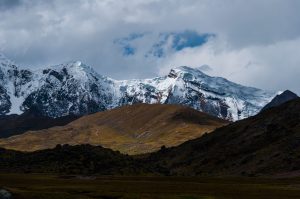
On the high plateau of Puno, near the shores of Lake Titicaca, the land stretches outward in quiet immensity. The wind moves without obstruction. The sky appears larger than elsewhere, as if distance itself had expanded. In this environment of elemental simplicity, a carved doorway rests against a massive rock formation.
It does not open.
It does not lead inside.
And yet, it remains one of the most unsettling presences in the Andean world.

Summary
The Geography of Emptiness
The altiplano is not dramatic in the conventional sense. It does not rise abruptly like Cusco’s mountains nor descend into lush valleys. Its power lies in openness — in the uninterrupted meeting of land and sky.
This geographical vastness shapes perception.
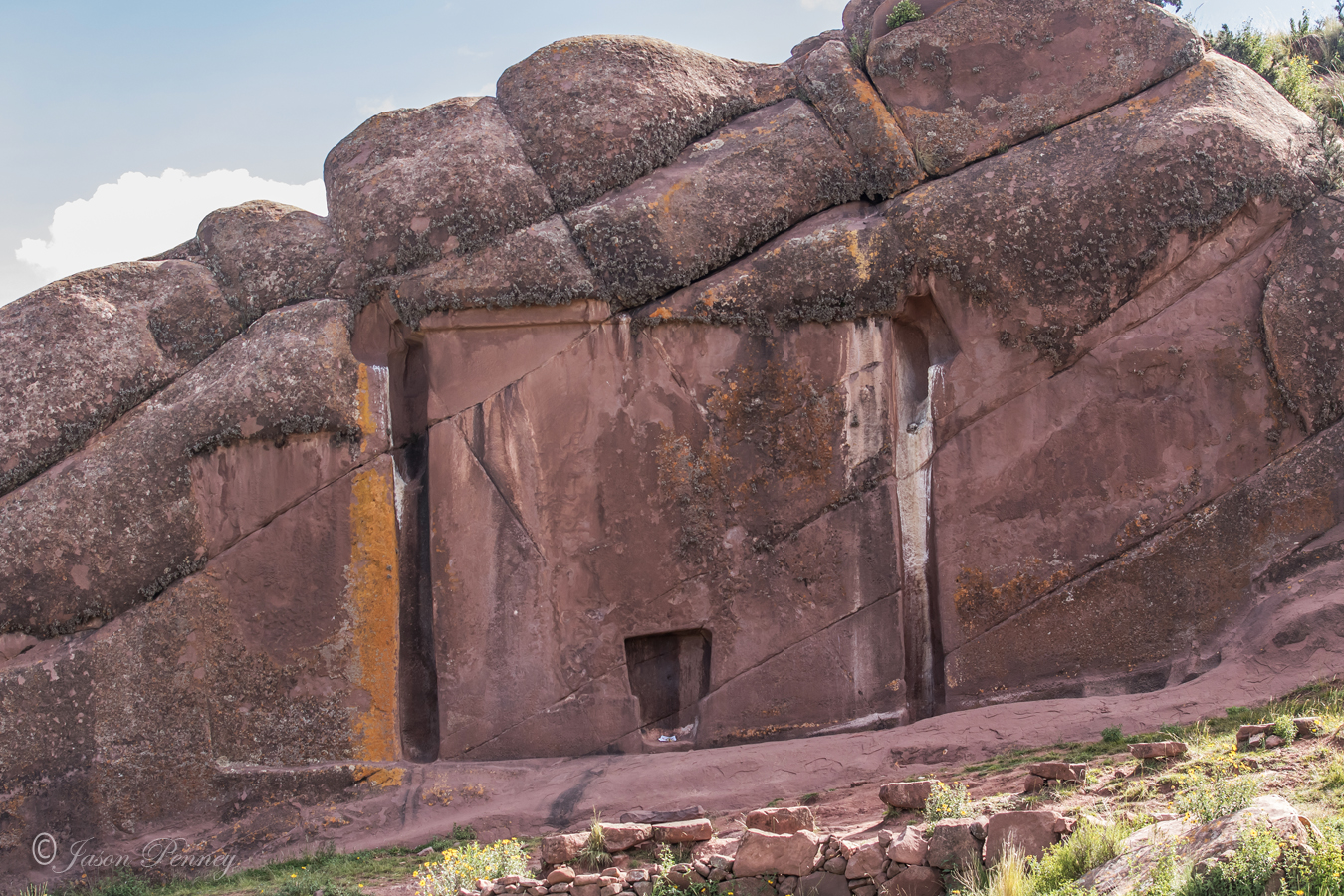
When one approaches Amaru Muru, there is no gradual reveal. No dense vegetation hiding it. No architectural complex announcing its importance. The site appears almost unexpectedly, carved into a reddish sandstone outcrop.
The emptiness surrounding it is not absence. It is framing.
The plateau creates a natural stage where the doorway stands alone, without distraction. No competing monuments. No urban noise. Only wind, rock, and horizon.
In this context, even a small carved recess becomes monumental.

A Doorway Without Passage
At first glance, the structure is deceptively simple: a large rectangular carving recessed into the stone, with a smaller niche at its center. The proportions are intentional. The lines are controlled. The surface inside the recess is smoother than the surrounding rock.
But the most striking feature is what is missing.
There is no chamber beyond the door.
No tunnel.
No architectural continuation.
It is a threshold carved into solid stone — a door that does not open because it was never meant to open physically.
This absence of functional space forces interpretation inward. If there is no physical interior, then the doorway must point elsewhere.
Amaru Muru is not architecture of access.
It is architecture of suggestion.

The Serpent and the Three Worlds
The name “Amaru” refers to the serpent — a powerful symbol within Andean cosmology. The serpent is not merely an animal; it is a mediator between realms.
In Andean thought, existence is structured in three planes:
-
Hanan Pacha – the upper world (cosmic realm)
-
Kay Pacha – the present world (human realm)
-
Uku Pacha – the inner or lower world (subterranean realm)
The serpent moves between these dimensions.
If the doorway represents a symbolic passage, then it may embody this transitional space — not an entrance into a hidden room, but a conceptual crossing between states of being.
The small niche within the larger frame intensifies this idea. It suggests focalization — perhaps a space for ritual object placement, perhaps alignment, perhaps something entirely symbolic.
Amaru Muru does not confirm.
It implies.
Stone as Conscious Matter
Within Andean worldview, stone is not inert material. Mountains are Apus — living presences. Earth is Pachamama — conscious and reciprocal. Carving stone is not simply shaping matter; it is engaging with a living element.
This changes the interpretation entirely.
Rather than seeing Amaru Muru as something imposed upon nature, it may be understood as something revealed from it — as if the doorway had always existed within the rock, waiting to be outlined.
The precision of the carving contrasts with the organic irregularity of the formation around it. The human intervention is evident, yet restrained.
The rock remains dominant.
The carving respects it.
Ritual Without Spectacle
Unlike monumental Inca sites, Amaru Muru lacks terraces, plazas, and elaborate construction. There is no grand architectural program here.
This minimalism is intentional.
Sacredness in the Andes does not always manifest through scale. Sometimes it emerges through alignment — with cardinal directions, celestial movements, or energetic nodes in the landscape.
The absence of architectural excess suggests that the stone itself was already significant before it was carved.
The intervention was subtle.
The power was pre-existing.

Myth as Structural Layer
Local legend tells of priests who fled Spanish conquest carrying sacred golden discs of knowledge. According to the story, they activated this doorway and passed into another dimension, disappearing into the stone.
From a historical standpoint, such narratives are unverifiable. From a cultural standpoint, they are essential.
Myth here is not fantasy — it is preservation of worldview.
The story survives because the structure accommodates it. The carved doorway invites narrative. It offers just enough ambiguity to sustain belief.
And belief shapes experience.
Amaru Muru becomes a vessel not just of stone, but of collective imagination.
The Psychology of Ambiguity
Modern architecture tends toward clarity: doors lead somewhere, walls divide space, function is explicit.
Amaru Muru resists this logic.
Its ambiguity creates psychological tension. The mind seeks resolution — an explanation, an interior, a purpose. When none is provided, perception shifts inward.
The visitor begins to project meaning.
In this sense, Amaru Muru operates as a mirror. It reveals more about the observer’s interpretive framework than about its own definitive function.
Skeptics see unfinished ritual carving. Mystics see portal. Historians see ceremonial site. Spiritual seekers feel energy.
The stone remains silent.
Time Without Urgency
There is no prescribed movement at Amaru Muru. No path to ascend, no route to follow. Visitors approach, stand, observe, and remain.
The absence of structured movement alters time perception.
Minutes stretch.
Wind becomes noticeable.
Subtle variations in light gain significance.
Without distraction, awareness intensifies.
Amaru Muru does not command action.
It commands stillness.
Energy, Environment, and Perception
Many report unusual sensations at the site: shifts in temperature, tingling in hands, emotional calm. Whether these experiences arise from altitude, suggestion, or environmental conditions is secondary.
What matters is that the site modifies perception.
The high altitude reduces oxygen slightly. The wind isolates sound. The open horizon eliminates visual clutter. All of these environmental factors heighten sensitivity.
Perhaps Amaru Muru does not generate energy.
Perhaps it removes interference.
When distraction is stripped away, perception sharpens.
The Discipline of Unanswered Questions
In contemporary culture, uncertainty is often uncomfortable. We seek definitive explanations, clear historical categorization, measurable data.
Amaru Muru offers none of this conclusively.
And this absence becomes instructive.
To stand before something intentionally ambiguous requires intellectual humility. It requires acceptance that not all ancient structures fit neatly into modern frameworks.
The doorway teaches tolerance for mystery.

Not Grand — Yet Infinite
Physically, the carved frame is modest. It does not overwhelm through dimension. Yet conceptually, it opens toward infinity.
A door carved into solid rock challenges the assumption that passage must be physical. It suggests that crossing can occur in awareness rather than space.
The scale is human.
The implication is cosmic.
The Relationship with Lake Titicaca
Nearby lies Lake Titicaca — one of the highest navigable lakes in the world, deeply embedded in Andean origin myths. It is said to be the birthplace of the sun in Inca cosmology.
Water and stone.
Fluid and fixed.
Origin and threshold.
Amaru Muru’s proximity to the lake deepens its symbolic resonance. If Titicaca represents emergence, Amaru Muru may represent transition — a movement from one state of consciousness to another.
Geography reinforces cosmology.

A Monument That Does Not Demand Belief
What makes Amaru Muru remarkable is not that it proves anything supernatural. It does not require belief to maintain presence.
It exists comfortably in ambiguity.
It does not insist.
It does not persuade.
It simply stands — carved, precise, unresolved.
Amaru Muru: Where Explanation Ends and Experience Begins
In the end, Amaru Muru is not about hidden chambers or secret dimensions. It is about the boundary between the measurable and the meaningful.
It challenges the idea that architecture must function physically to function symbolically.
It suggests that some thresholds are internal.
On the vast plateau of Puno, beneath a sky that feels eternal, the carved doorway remains embedded in stone.
Closed.
Intentional.
Silent.
And perhaps its greatest power lies not in what it hides,
but in what it refuses to explain.