
Huchuy Qosqo rises high above the majestic Sacred Valley of the Incas, more than 3,600 meters above sea level. This archaeological site combines history, mysticism, and breathtaking landscapes.
Its name in Quechua means “Little Cusco,” and although it doesn’t match the size of the ancient Inca capital, it possesses a unique charm that makes it one of the most fascinating sites of Andean heritage.

A Legacy of Inca Wiracocha
Huchuy Qosqo was commissioned by Inca Wiracocha around the 15th century as an administrative and agricultural center, and possibly as his temporary residence.
According to oral tradition, Wiracocha decided to retreat to this site during his reign, attracted by its temperate climate and privileged views of the Urubamba Valley.
The archaeological site is strategically located on a natural plateau overlooking the valley, which not only provided defensive advantages but also broad visual control of the farmlands and communication routes. From there, you can see the course of the Vilcanota River winding between the towns of Calca, Lamay, and Pisaq, as well as the mountains that frame the horizon.

Architecture that Defies Time
Despite its relatively small size, Huchuy Qosqo is striking for the quality and uniqueness of its architecture. The main buildings were built with finely hewn stone walls at the base and adobe bricks at the upper levels, a rare combination at Inca sites, suggesting adaptation to the terrain and climate.
Among the most notable buildings are:
-The main kallanka, a large rectangular hall more than 40 meters long, which was likely used for ceremonies, assemblies, or housing administrative staff.
-The warehouses or qolqas, which served to store agricultural products, are a testament to the efficient management of resources and Inca state planning.
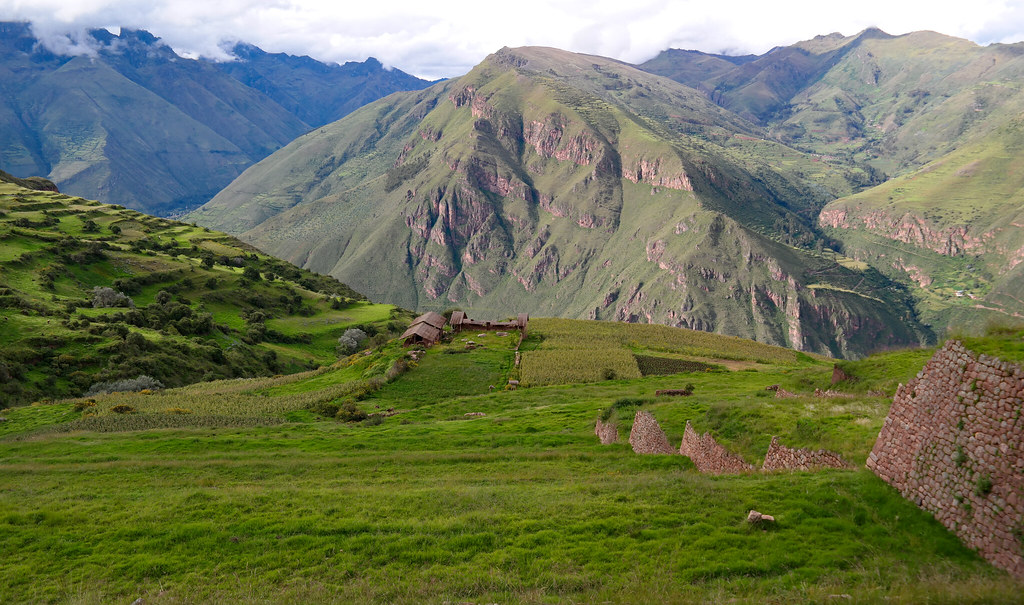
-The agricultural terraces, which cover the surrounding slopes and demonstrate impressive mastery of Andean hydraulic and agricultural engineering.
Remains of irrigation canals and stone staircases connecting the different levels of the settlement are also observed, demonstrating the level of organization and technical sophistication achieved by the Incas.


A Living Cultural Landscape
Beyond the ruins, Huchuy Qosqo blends harmoniously into its natural surroundings. The path to the site passes through landscapes of great beauty: deep ravines, slopes covered with ichu trees, high-altitude lagoons, and small villages that preserve ancestral traditions.
The site is located between the towns of Tauca, Lamay, and Calca, in the Cusco region. From any of these points, the routes to reach it combine original Inca trails and communal paths, offering an experience of direct contact with nature and Andean rural life.
Along the way, it is common to encounter llama and alpaca herders, women weaving along the paths, and children waving curiously.
The pure air, the silence of the mountains, and the sound of the wind accompany every step, evoking the sensation of walking through a sacred place.

A Viewpoint in the Sacred Valley
Arriving at Huchuy Qosqo also means arriving at an exceptional natural viewpoint. From its main platform, you have an incomparable panoramic view of the Sacred Valley of the Incas. The light of sunrise and sunset colors the mountains in golden hues, and the contrast between the deep blue sky and the green of the valleys creates an almost magical atmosphere.
It’s not uncommon for visitors to describe this place as a place “out of time.” The energy emanating from the ruins, along with the solitude of the landscape, invites introspection and contemplation. Huchuy Qosqo is not only an archaeological destination, but also a spiritual experience that connects with the very essence of the Andes.

Myth, Memory, and Continuity
According to tradition, after the death of the Inca Wiracocha, his mummy was moved to Huchuy Qosqo and venerated there for generations, until the Spanish, upon arriving in the valley, desecrated the site and destroyed the remains. Even so, the memory of Wiracocha and his retreat at these heights remains alive in the communities surrounding the site.
Today, Huchuy Qosqo is more than an archaeological ruin: it is a testament to the balance between man and nature, an example of the Andean worldview where landscape and architecture become one.
The farmers of the area continue to cultivate the terraces, honoring the legacy of their ancestors.

Access and Cultural Context
Huchuy Qosqo is located in the Lamay district, in the province of Calca, about 50 kilometers north of the city of Cusco. Although less visited than other destinations in the Sacred Valley, its access via ancestral roads makes it especially attractive for those seeking an authentic experience.
The routes connecting to the site pass through puna landscapes, deep ravines, and small farming communities that keep Quechua traditions alive. Travelers can observe agricultural techniques inherited from the Incas, traditional weaving, and a daily life deeply connected to the land.
The communities in the area, such as Tauca, Chinchero, and Lamay, are actively involved in site conservation and community-based tourism, promoting respectful contact with the local culture.

Archaeological and Heritage Importance
Huchuy Qosqo was declared a National Cultural Heritage Site by the Peruvian Ministry of Culture for its historical and architectural value. Although excavations and studies have been limited compared to other Inca sites, recent research has identified residential areas, storage facilities, and agricultural sectors that broaden our understanding of its function.
The site is considered to have played a political, administrative, and religious role, as well as being an example of how the Inca planned their settlements based on the landscape, altitude, and availability of water resources.

A place that unites history, landscape, and spirit
Visiting Huchuy Qosqo is an experience that goes beyond archaeological tourism. It is an encounter with the living history of the Andes, a journey to the spiritual heart of the Inca Empire.
The silence of the mountains, the echo of the wind among the ruins, and the sensation of being suspended between the sky and the valley make this place a refuge for reflection and wonder.
Huchuy Qosqo not only tells the story of the Incas, but also that of the people who, centuries later, continue to inhabit and care for these lands with the same respect as their ancestors.