
It is a point where movement pauses—not out of fatigue, but out of awareness. A place where the path stops being mere transit and becomes meaning. Those who reach it do not simply arrive: they cross.
Inti Punku does not welcome the traveler.
It observes them.

Summary
A Threshold, Not a Destination
In modern logic, places exist to be reached. In Andean logic, some places exist to be crossed. Inti Punku belongs to the latter.
It is neither an endpoint nor a place of permanence. It is a symbolic threshold between effort and revelation, between movement and understanding, between the external world and sacred space.
Reaching Inti Punku requires prior commitment. It is never accidental. It demands walking, time, adaptation, and silence. Its value lies not in what it shows, but in when it shows it.
Architecture of Precise Timing
The Inca never built randomly. Every structure responded to intention, environment, and natural cycles. Inti Punku is no exception.
Its position is deliberate. It is placed to reveal—not display—the landscape at the exact moment. The view does not impose itself early. It appears only after the body has been tested, the mind quieted, and the path has done its work.
Here, architecture does not frame space.
It controls time.

The Body as Part of the Design
Inti Punku cannot be understood without the body. Breathing, fatigue, and pace are part of the experience. This place was not meant to be observed comfortably, but encountered through effort.
The body arrives transformed. Altitude, distance, and terrain reshape perception. That is why, when the landscape finally unfolds, it is received differently than any easily accessible viewpoint.
Inti Punku proves that for the Inca, the body was an instrument of knowledge—not an obstacle.
Landscape as Response, Not Spectacle
From Inti Punku, the environment opens. But it does so without exaggeration or theatricality. The revelation is restrained, almost sober. There is no visual excess, no artificial drama.
The landscape responds to the journey. It is consequence, not reward.
This reverses modern tourist logic, where spectacle is immediate. At Inti Punku, beauty arrives when it is no longer demanded—when the traveler has learned to look without expectation.
Gates That Connect, Not Divide
In many cultures, gates separate spaces: inside and outside, allowed and forbidden. Inti Punku does not divide.
It connects.
It connects the road to the destination, the human to the sacred, effort to contemplation. It is not a barrier, but a conscious transition.
Crossing Inti Punku does not mean leaving something behind—it means understanding what has been walked.

Many Inti Punku, One Idea
Inti Punku is not a single place. Several exist across the Andean world. All follow the same logic: strategic points where the journey shifts in symbolic meaning.
This reveals that Inti Punku is not an isolated structure, but a concept—a way of understanding territory as a sequence of states rather than a continuous line.
Each Inti Punku marks a before and an after.
Silence as a Condition
Inti Punku does not function in noise. Its power depends on silence—external and internal.
Language becomes unnecessary here. There are no explanations, no instructions. The place does not teach through words. It demands presence.
Silence is not emptiness.
It is the space where meaning can appear without being forced.

Andean Worldview: Nothing Is Immediate
In Andean cosmology, knowledge is never instant. It is built through process, cycles, and experience. Inti Punku embodies this principle perfectly.
Nothing is given without preparation. Nothing is revealed without context. Value lies not in arrival, but in how one arrives.
This logic runs through Inca engineering, spirituality, and social organization.
Inti Punku and the Control of Ego
Inti Punku does not feed the traveler’s ego. It does not invite conquest or personal glorification. It does not say “you made it.” It says, “now observe.”
There is no triumph here. There is pause.
In a world that celebrates speed and accumulation, Inti Punku proposes the opposite: stopping when one could continue, observing when one could advance.
The Sun, Orientation, and Order
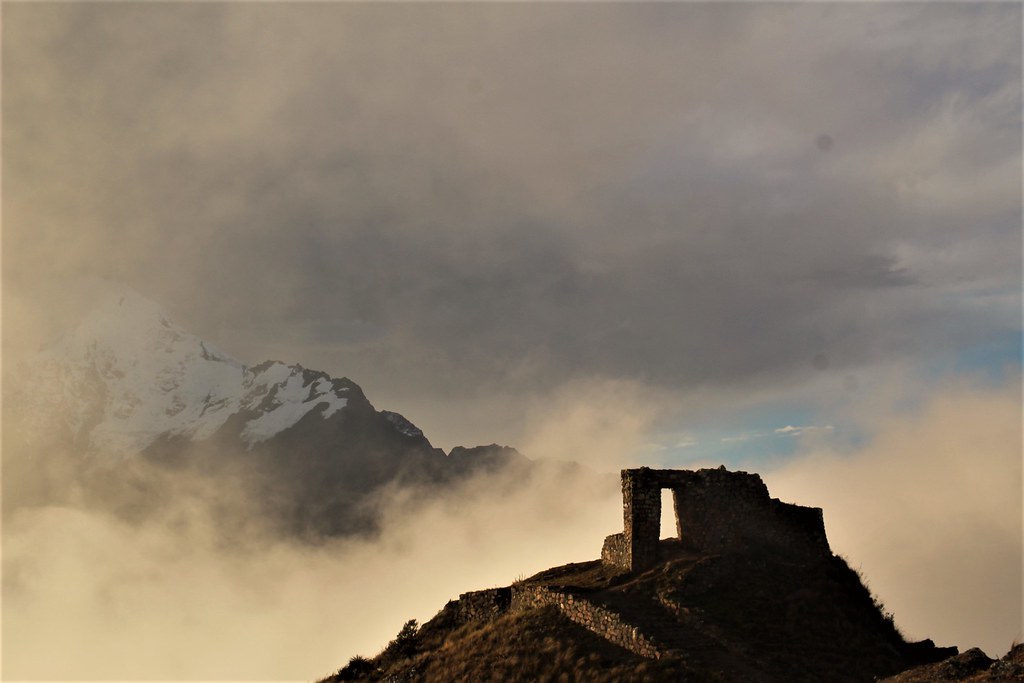
The name Inti Punku—Gate of the Sun—is not metaphorical. Its relationship with sunlight, orientation, and celestial cycles is precise. The structure engages directly with solar movement, reinforcing a vision of cosmic order.
Here, the landscape is not merely geographic. It is astronomical, temporal, and symbolic.
The traveler does not enter a place alone, but a worldview where the universe follows structure.
Resistance to Simplification
Inti Punku is often reduced to a “viewpoint” or “photo stop.” This reduction strips it of meaning. It is not a scenic platform. It is a spatial idea loaded with intention.
To reduce it to an image is to lose it.
Inti Punku cannot be understood through speed or consumption. It requires context, patience, and the willingness to not understand everything immediately.
A Lesson That Is Never Explained
There is no clear lesson at Inti Punku. No moral. No final conclusion.
And this is intentional.
Knowledge here is not delivered as information, but as experience. Each person crosses Inti Punku with a different understanding, shaped by their own process.
Inti Punku as a Metaphor for the Conscious Journey
Beyond its historical function, Inti Punku becomes a powerful metaphor for meaningful travel. Not everything opens immediately. Not everything should be accessible. Not everything exists to be consumed.
Some things exist to remind us that meaning is earned, not demanded.
When the Path Fulfills Its Purpose
Inti Punku marks the moment when the journey stops being movement and becomes understanding—not because something ends, but because something aligns.
Here, travel turns inward.
Inti Punku: The Art of Arriving Without Hurry
Inti Punku does not promise. It does not seduce. It does not call.
It simply stands there, waiting for those willing to arrive with a tired body, an open mind, and a quiet ego.
It is not a gate to enter.
It is a gate to understand.
And those who cross it
never walk the same way again.
Inti Punku was not designed to impress through size or ornamentation, but through intention and placement. Its power lies in anticipation rather than arrival. Reaching this threshold requires effort, patience, and ascent, reinforcing the idea that access to sacred or meaningful spaces is never immediate. The act of walking toward Inti Punku mirrors an internal process: leaving behind distraction, adjusting to silence, and preparing the mind before entering what lies beyond. In this way, Inti Punku functions not only as a physical gateway, but as a psychological and spiritual filter — a reminder that transformation begins before the destination is reached.