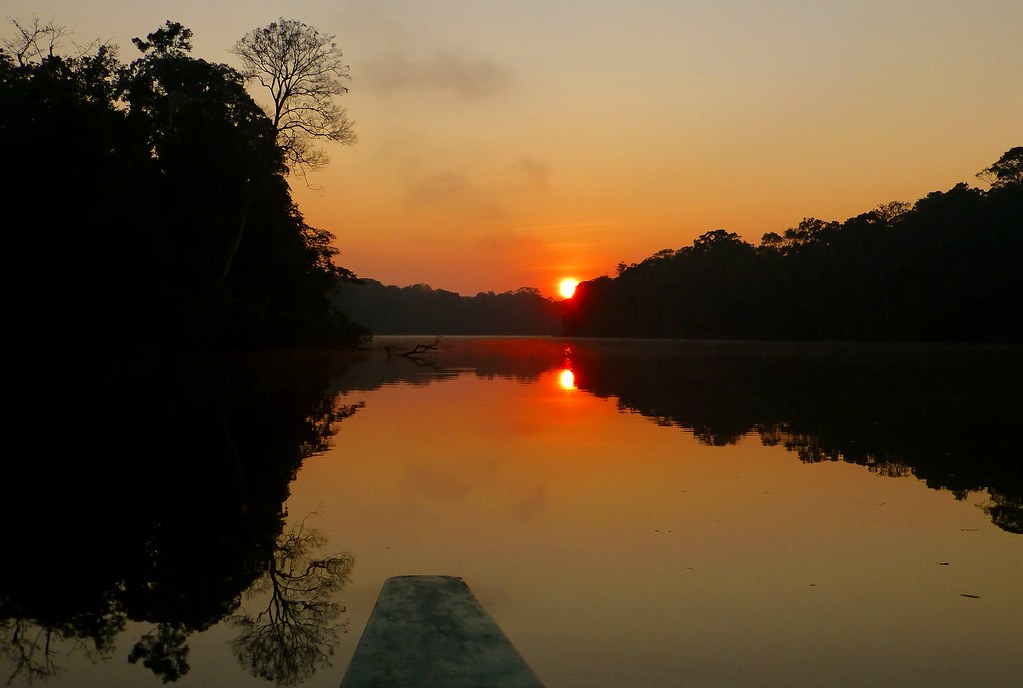

Manu, in southeastern Peru, is a place where the Andes slowly dissolve into the Amazonian wilderness, giving rise to one of the most astonishing natural refuges on the planet.
This vast territory of more than 1.7 million hectares an area larger than some European countries encloses a complex network of ecosystems where life manifests itself in its purest and most exuberant form.
Declared a Biosphere Reserve by UNESCO in 1977 and a World Heritage Site in 1987, Manu is considered one of the places with the greatest biological diversity on the planet.
What makes it so special is not only its size, but its ecological gradient: in just a few days, you can go from the high Andean glaciers to the most humid tropical rainforest, passing through cloud, montane, and Amazonian forests. Each area is home to unique species, many still unknown to science.


A Geography That Connects Worlds
Manu is located between the departments of Cusco and Madre de Dios, encompassing the eastern slope of the Andes and part of the Amazon plain.
This altitude range, from 4,200 meters above sea level to just 200 meters, generates a series of microclimates and landscapes in constant transition.
At higher altitudes, the cloud forest is covered by persistent mists that moisten the foliage and give life to the ferns, mosses, and orchids that grow on the tree trunks.
It is home to the Cock-of-the-Rock (Rupicola peruvianus), one of Peru’s most beautiful and emblematic birds, which displays its intense orange plumage in a courtship ritual that seems choreographed by the forest itself.
As you descend, the temperature rises, the trees grow taller, and the forest becomes a sea of green without a horizon. In the lower reaches, rivers meander through the morning mist, vines hang like natural bridges, and every sound the flapping of a toucan’s wings, the distant roar of a jaguar, the buzzing of insects reminds us that this ecosystem is alive in every corner.

A realm of unparalleled biodiversity
Manu National Park is, without exaggeration, a global epicenter of biodiversity. It is estimated to be home to one of the highest concentrations of life on the entire planet.
-Flora: More than 4,000 plant species have been identified, including giant Amazonian trees that reach 50 meters in height, as well as countless species of orchids, bromeliads, and medicinal plants. Many of these species have yet to be scientifically described.

-Birds: More than 1,000 bird species fly over Manu, representing nearly 10% of all known birds in the world. From the vibrant macaws that congregate on the clay licks (clay walls where they feed on minerals) to the elusive harpy eagle, the sky above Manu is a constantly moving spectacle.

-Mammals: More than 160 species of mammals lurk in the depths of the forest, including the jaguar, the Amazonian tapir, the giant armadillo, and the spider monkey. In the lagoons, you can see the playful giant otters—an endangered species—swimming with their families.

-Amphibians, Reptiles, and Insects: The lowland rainforest is home to more than 200 species of reptiles and amphibians, and an incalculable number of insects. Scientists have recorded more than 1,000 different insect species in just one tree, making Manu a universe within a universe.
Every corner seems designed to remind visitors that life not only exists: it abounds, reinvents itself, and adapts.

The Role of Amazonian Communities
Beyond its biodiversity, Manu is also home to invaluable cultural wealth. Communities such as the Machiguenga (Matsiguenka), Yine, Amahuaca, and Piro live in the buffer zone, maintaining ancestral traditions in harmony with the environment.
Their knowledge of medicinal plants, hunting and fishing techniques, and the stories they pass down from generation to generation are an essential part of the park’s ecological and spiritual balance.
In the most remote interior of Manu, peoples live in voluntary isolation, such as the Mashco-Piro, who have chosen to remain on the fringes of modern civilization.
Their existence reinforces the importance of conserving these lands not only as a natural refuge, but also as a human sanctuary, where freedom and respect for life reach their fullest expression.
A Sanctuary in Motion
Manu is not a static park. It is a living organism that changes with the seasons, the rains, and the cycles of wildlife. During the rainy season, rivers overflow and transform the landscape, flooding the forest margins and nourishing the soil.
During the dry season, river beaches emerge as life-filled settings: alligators rest in the sun, birds fish in the calm waters, and animal tracks mark the damp sand.
This natural dynamism is also reflected in the sky. At dawn, a golden mist covers the jungle, and little by little, the light reveals the details of a seemingly infinite universe.
At night, the sound of rain or the distant chirping of insects accompanies the profound silence that only the jungle can offer.

Conservation and Responsible Tourism
Visiting Manu means entering an extremely fragile ecosystem. Therefore, tourism is carefully regulated to ensure minimal human impact. Only a small portion of the park is open to the public; the rest remains an untouched area, designated exclusively for conservation and scientific research.
The presence of sustainable eco-lodges and certified local guides has allowed tourism to become a tool for preservation. Each visit provides financial resources that help protect the park and the communities that inhabit it.
However, beyond financial support, responsible tourism in Manu has a spiritual value: connecting with nature through respect. It’s not about “visiting the jungle,” but rather understanding that we are part of it, that its balance also depends on our daily decisions, even far from the Amazon.

The silence that teaches
In Manu, time takes on another dimension. There is no cell phone signal, no engine noise, no digital distractions. What remains is the sound of the wind, the chirping, the footsteps on the fallen leaves. For many visitors, this disconnection becomes a form of inner encounter.
Walking its trails or navigating its rivers is not just a visual experience: it’s a learning process. One discovers the logic of trees cooperating with each other, the water cycle that sustains life, the language of animals that communicate without words.
Manu teaches without speaking, and those who visit it with an open heart come away different.

A Heritage for the Future
The value of Manu National Park transcends Peru’s borders. It is a World Heritage Site, a reminder of what the planet was like before industrialization and what it can still be if protected wisely.
Science has barely explored a fraction of its biological wealth. It is estimated that there are thousands of species still unknown, and each scientific expedition brings new surprises: frogs that change color, plants with unique medicinal properties, insects with behaviors never before observed.
In a world facing climate crises and accelerated biodiversity loss, Manu is a symbol of hope. It represents the possibility of balance between humans and nature, between progress and preservation.

Conclusion: The Soul of the Jungle
Manu National Park is not just a tourist destination: it is a journey to the origin of life. Those who visit this corner of the planet understand that the jungle needs no adornments or artifices.
Its beauty lies in its authenticity, in the harmony that reigns among living beings, in the mystery that still lies within its ancient trees.
Manu is not conquered or explored: it is breathed, heard, and felt.
And those who have the privilege of experiencing it carry with them the certainty of having been, for a moment, in the untouched heart of the world.