
There are places in the world that welcome the traveler, that explain themselves through beauty, color, or immediacy. Nazca does the opposite. It withdraws. It removes excess. It strips experience down to essentials until only questions remain.
In a desert where almost nothing survives, meaning was deliberately placed — not raised, not decorated, not glorified — but drawn into the land itself.
Nazca is not a destination.
It is a decision.

Summary
Creation in a Landscape That Offers Nothing Back
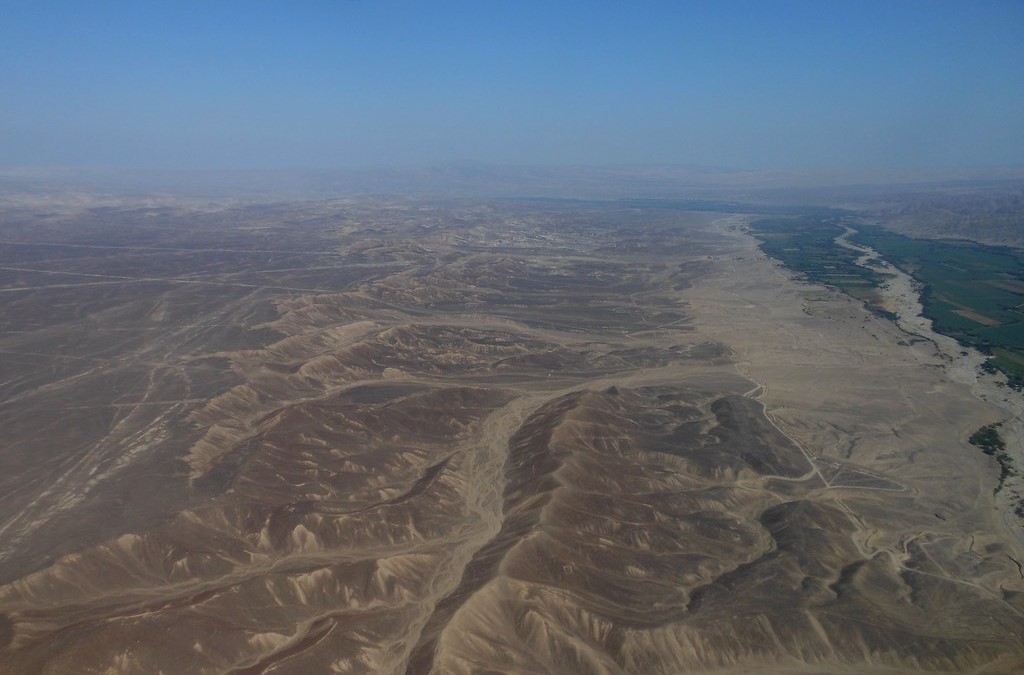
The Nazca Desert offers no reward. There is no fertile soil, no shade, no visual softness. Wind erases tracks, heat exhausts the body, and the horizon rarely changes. Any act of creation here demands intention strong enough to overcome discomfort.
This makes the Nazca Lines radically different from monuments built in abundance. They were not supported by wealth, surplus, or ease. They were executed where effort was costly and survival already required focus.
To create here was to choose discipline over necessity.
Nazca asks a silent question:
What does humanity create when nothing encourages it to do so?

A Civilization Fluent in Restraint
Nothing in Nazca is excessive.
No line is decorative.
No figure is accidental.
The restraint is striking. Where other cultures filled space, Nazca respected it. Where others built upward, Nazca expanded outward. The desert was not conquered — it was measured.
This restraint suggests a society that understood limits. Not only physical limits, but conceptual ones. Meaning did not require complexity. Precision was enough.
Nazca proves that sophistication does not demand ornamentation.
Lines That Ignore the Human Body
Most architecture is built for bodies — to enter, to rest, to gather. The Nazca Lines ignore the human scale entirely. They stretch far beyond physical interaction. They cannot be walked as a whole, touched as a form, or understood from within.
This makes them unsettling.
They do not accommodate the individual. They demand abstraction. They require the observer to imagine a viewpoint that was never physically available to their creators.
Nazca is design that rejects comfort.
It asks humans to think beyond themselves.
Geometry as Language
Nazca communicates without sound, without symbols, without text. Its language is geometry — straightness, repetition, proportion, alignment. These are not aesthetic choices; they are structural ones.
Geometry does not persuade.
It asserts.
A straight line across kilometers of desert is not expressive — it is declarative. It states that intention matters more than terrain, that vision overrides immediate obstacles.
In Nazca, geometry replaces speech.
And it speaks with authority.

Effort Without Immediate Utility
There is no evidence that the lines provided direct material benefit. They did not irrigate fields, shelter populations, or generate resources. Their value was not practical in a modern sense.
This challenges contemporary assumptions that value must be measurable, immediate, or productive.
Nazca introduces a different metric:
effort justified by belief.
Not belief as doctrine, but belief as commitment to continuity, alignment, and purpose beyond survival.
Collective Intelligence Over Individual Recognition
Nazca is anonymous by design. No name survives. No leader is commemorated. No personal legacy is preserved. The work is communal and persistent, spanning generations without claiming ownership.
This absence of ego is radical.
Modern societies reward visibility, authorship, and personal credit. Nazca rejects all three. The work mattered more than the maker.
This suggests a form of intelligence that prioritized continuity over identity.
Time as a Construction Material
Nazca was not created quickly. It required repetition, maintenance, and long-term commitment. Lines had to be preserved, paths cleared, shapes maintained against erosion.
Time was not an obstacle — it was a collaborator.
This long-term thinking contrasts sharply with modern urgency. Nazca was not built to impress contemporaries. It was built to persist.
Its success is measured in endurance, not reaction.
The Desert as an Archive
The Nazca Desert did not merely host the lines — it preserved them. Its dryness, stability, and isolation turned the land into an archive far more reliable than paper or stone.
This partnership between human intention and natural conditions reflects deep environmental awareness. Nazca did not fight nature. It aligned with it.
Creation here was ecological, even if symbolic.

Meaning Without Explanation
One of Nazca’s most powerful qualities is that it offers no definitive explanation. No myth survived intact. No instruction manual remains. Interpretation is inevitable, but resolution is impossible.
This ambiguity is not a failure of understanding — it is a feature of the work itself.
Nazca resists closure.
It refuses to be finished.
In doing so, it remains intellectually alive.
The Ethics of Effort
Nazca raises ethical questions rarely asked today:
-
Is effort still meaningful without visibility?
-
Can creation exist without consumption?
-
Does meaning require explanation to remain valid?
By existing quietly, Nazca argues that effort itself can be a form of truth.
A Civilization Thinking in Systems
Nazca was not an isolated act. It was part of a broader system that included water management, agriculture, observation of cycles, and social organization. The lines reflect a worldview grounded in pattern recognition and environmental attunement.
This was not abstract spirituality disconnected from reality. It was applied awareness expressed symbolically.
Nazca is thought made visible — but not simplified.
Silence as Intellectual Space
Standing in Nazca, silence becomes tangible. It removes distraction and amplifies perception. In this silence, scale becomes clearer. Lines feel heavier. Questions linger longer.
Silence is not absence here.
It is structure.
Without silence, Nazca would lose its force.

Resistance to Modern Consumption
Nazca does not photograph easily. It cannot be summarized in a sentence. It does not reward speed. It resists being reduced to content.
This resistance protects its integrity.
Nazca cannot be owned by attention. It requires patience, humility, and intellectual effort — qualities increasingly rare.
Nazca as a Mirror
Ultimately, Nazca reflects the observer more than itself. Those seeking mystery find mystery. Those seeking science find engineering. Those seeking belief find ritual.
But none of these interpretations exhaust its meaning.
Nazca exposes the limits of interpretation itself.
Beyond Mystery: Discipline, Choice, Permanence
Nazca is often described as mysterious. But mystery implies ignorance. What Nazca truly represents is discipline — sustained effort guided by purpose, executed without expectation of reward.
It is not an accident.
It is not improvisation.
It is not chaos.
It is choice, repeated over time.

Nazca: When Humanity Thought Beyond Itself
In the vast neutrality of the desert, humans once chose to leave evidence not of power, but of intention. They created something larger than individual lives, invisible from the ground, resistant to explanation, and indifferent to recognition.
Nazca does not celebrate humanity.
It challenges it.
And in doing so, it becomes one of the most profound expressions of what humans are capable of when meaning matters more than visibility.