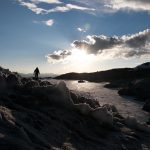

Quelccaya, a hidden white world that seems like something from another planet, is located in the middle of the Vilcanota mountain range, at over 5,500 meters above sea level in the Cusco region of Peru. Its name in Quechua means “ice cap,” and it’s no coincidence… because it’s the largest tropical glacier in the world.
Quelccaya isn’t just an incredible place to visit. It’s also a kind of “ice library”: records of thousands of years of climate history are kept within it.
Scientists drill into the glacier to study how the climate has changed in the Andes, and thanks to this, we know that Quelccaya is a silent witness to the past… and also a warning about the future.
The problem is that global warming is causing it to retreat every year. Since the 1980s, it has lost more than 40% of its surface area, and experts say that if we continue like this, we could see it disappear in just a few decades.


🏔Journey to the Heart of the Ice
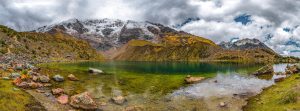
To reach Quelccaya, the most popular route starts in Cusco and heads toward the Pitumarca district. Then, you continue to Phinaya, a small pastoral community surrounded by mountains and alpacas. From there, the real adventure begins: a hike (or horseback ride) that takes you through puna landscapes, blue lagoons, and intense skies until you come face to face with the immense ice plateau.
The trek can take a couple of days and isn’t easy: the cold is intense, the air is thin, and the high-altitude sun is scorching. But when you arrive and see that endless expanse of white, you understand why it’s worth it.
🌄Andean Magic
For the local communities, Quelccaya means a lot. It’s not just a glacier. It’s an Apu, a sacred mountain, a spirit that protects and gives life. Its waters feed rivers and lagoons that are essential for the area’s grazing and agriculture. Hiking near it isn’t just about tourism: it’s about coming into contact with the Andean worldview, with that profound connection between humans and nature.
Local communities like Phinaya and Sallani have a deep connection to the glacier as part of their environment, their cosmology, their rituals, and their way of life. The glacier is more than a resource; it’s part of their identity.

🧭 Natural, Scientific, and Environmental Importance
- Quelccaya contains ancient climate records (ice cores) that allow for the study of the climate history of the tropical Andes, with details of rainfall, droughts, and other atmospheric changes.
- It is experiencing a very accelerated retreat due to climate change. Since 1985, it has lost approximately 42% of its area and more than 61% of its snow cover.
- According to recent studies, the main glacier tongue (“Qori Kalis”) is retreating at increasing rates, resulting in volume loss, an increase in periglacial lakes, and impacts on water for communities and ecosystems.
- There is a project to declare the area a Geopark (“Geoparque Quelccaya”), with a declaration of national interest, to promote conservation, scientific research, and sustainable tourism.
⚠ Challenges & Alerts
- Climate change is seriously affecting Quelccaya. As I mentioned, the loss of ice, the increase in lagoons due to melting, and the increasing annual retreats.
- In some scenarios, it is estimated that its ice cover could be halved in the coming years if conservation measures are not adopted.
- The creation of the geopark faces challenges of institutional coordination, protection from extractive activities, and ensuring that tourism is sustainable and does not harm ecosystems or local ways of life.
🧭 Tips for your visit
- If you’re thinking of visiting Quelccaya, keep in mind:
- Acclimatize in Cusco a few days beforehand. The glacier is above 5,000 meters above sea level.
- Basic equipment: a heavy coat, sunscreen, sunglasses, good footwear, and a sleeping bag if you plan to camp.
- Travel with local guides: not only for safety, but also because they can teach you legends, customs, and secrets of the area.
- Absolute respect: don’t leave trash, don’t damage the ice or the flora. You are in a fragile and sacred ecosystem.
🥾 The experience of reaching Quelccaya
The adventure to Quelccaya begins long before you see the glacier. The journey from Cusco to Phinaya, a small Andean village surrounded by alpacas and llamas, is a journey in itself. There, life unfolds calmly, with shepherds who seem oblivious to the hustle and bustle of the modern world. It’s the last breath of civilization before entering a seemingly endless landscape.
The trek to the glacier is arduous, but each step offers unforgettable views: streams cascading down the mountains, turquoise lagoons reflecting the clouds, and a profound silence that makes you hear your own breathing. There’s no cell phone signal, no car noise, just you, the mountain, and the wind.
As you advance, the air becomes thinner, and each inhalation takes a little more effort, but the thrill of getting closer to the “white giant” drives you forward. The cold cuts through your skin and the Andean sun burns intensely, a strange combination only felt at high altitude.
And suddenly, there it is: an ice plateau that seems to go on forever. The Quelccaya Glacier appears like a frozen sea, with walls of ice that glisten in the sunlight. You’re speechless, because you know you’re standing before something unique: the largest tropical glacier on the planet.

🌿Emotion and Reflection
Standing in front of Quelccaya is like feeling small. Not only because of its imposing size, but because you know that the ice has been there for thousands of years… and that today it’s rapidly retreating. It’s impossible not to think about climate change and how this giant of the Andes is slowly melting.
But beyond the worry, there’s also beauty. The silence is so pure that it almost feels like a natural temple. Many travelers describe it as a spiritual place, a space to connect with Pachamama and with oneself.

🌄 What makes Quelccaya unique
Unusual landscapes: it’s not a mass tourist destination, so you’ll feel like you have the glacier all to yourself.
Andean authenticity: sharing moments with local shepherds, seeing how they live in harmony with the mountains.
True adventure: it’s not a comfortable hike; it’s challenging, authentic, and rewarding.
A destination that touches the heart: it’s not just about “seeing a glacier,” but about living an experience that combines nature, culture, and reflection.

✨ A lasting experience
Visiting Quelccaya is much more than just seeing a glacier. It’s experiencing the grandeur of the Andes, reflecting on climate change, and, above all, connecting with a land where nature still rules supreme.
If Machu Picchu is a symbol of the Incas’ glorious past, Quelccaya is a reminder of our planet’s present and future.