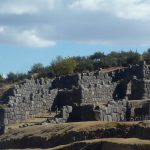

Sacsayhuaman with its gigantic walls, shaped like petrified lightning bolts, are living proof that the Incas didn’t just build with stone: they also built eternity. Sacsayhuaman is more than a fortress. It is a symbol, an enigma, and an altar. A site that silently guards the greatness of an empire and the secrets of a people who knew how to converse with the mountains and mold their strength into stone.


The Puma and the Lightning
The city of Cusco was designed as a great puma, a sacred animal to the Incas. Its body was the streets, its backbone the Tullumayo River, and its head, imposing and defiant, was Sacsayhuaman.
The zigzagging walls of the complex were not an aesthetic whim: they represented lightning (Illapa), a divine force that the Incas venerated as a bringer of rain and fertility. Thus, Sacsayhuaman was much more than a military bastion: it was a temple to the forces of heaven and earth.


The Enigma of the Colossal Stones
Nothing surprises the visitor more than the cyclopean walls of Sacsayhuaman. Blocks weighing up to 120 tons, fitted together with such perfection that even today they seem impossible to replicate.
The Spanish chroniclers were astounded. Garcilaso de la Vega wrote that neither iron nor gunpowder could break them, and that no one could understand how they had been carved and transported with such precision.
Modern archaeologists speak of ramps, rollers, and a titanic work organization. But many visitors prefer to believe that an unrevealed mystery lurks within Sacsayhuaman, and that these stones hold lost knowledge.
Sanctuary and Fortress
Sacsayhuamán had a dual purpose. On the one hand, it was a ceremonial site, where rituals to the sun, the moon, and Illapa, the divine lightning, were held. On the other, it was a strategic fortress that protected Cusco and controlled access to the valley.
From its towers and walls, Inca warriors watched the horizon, while on its esplanades, priests officiated ceremonies that united the human with the divine.

The Roar of the Conquest
In 1536, Sacsayhuaman was the scene of one of the most intense battles in Andean history. During the great rebellion of Manco Inca, the walls were converted into trenches and bastions.
Chroniclers narrate that the Inca warriors fought furiously, throwing stones, spears, and fire at the Spanish. There, Cahuide, a young nobleman who chose to throw himself from the top of a tower rather than be taken prisoner, died. His sacrifice became a symbol of resistance and courage.
That battle marked the destiny of Cusco: the flash of stone witnessed the fall of an empire, but also the indomitable spirit of its children.
Sacsayhuaman Alive: Festivals and Tradition
Today, Sacsayhuaman remains a scene of life and celebration. Its esplanades host Cusco’s most important festivities:
–Inti Raymi (Festival of the Sun): Every June 24, thousands of people recreate the Inca ceremony to the sun god. Dances, songs, and rituals revive the splendor of the Tahuantinsuyu.
–Corpus Christi: A procession that blends Catholic and Andean traditions, where sacred images travel through the city to reach the site, accompanied by music and devotion.
During these festivities, Sacsayhuaman ceases to be just a ruin and once again pulses as the spiritual center of the Andes.


Tips for your visit:
📍 Location
Just 2 km from the center of Cusco. You can get there on foot (30 minutes uphill) or by taxi.
🎟️ Admission
It’s included in the Cusco Tourist Ticket.
🕒 Recommended time
2 to 3 hours to explore the complex and enjoy its viewpoints.
🌞 Useful tips
-Go early or at dusk: the light enhances the majesty of the walls.
-Wear comfortable shoes: the terrain is wide and uneven.
-Bring water and sunscreen.
-Hire a local guide to better understand the Inca worldview.
-If you visit in June, don’t miss Inti Raymi: the festival of the sun in its original setting.
The Eternal Lightning
Sacsayhuaman is not just an archaeological site. It is an eternal lightning bolt, frozen in stone, that illuminates the history of Cusco and the memory of the Andes.
Its giant walls speak of ingenuity, spirituality, and resilience. They speak of a people who knew how to turn the mountain into a temple and of a legacy that, centuries later, continues to shine like a lightning bolt in the midst of time.
To visit Sacsayhuaman is to hear that lightning bolt. And whoever hears it will hardly forget it.