
Tambomachay is covered with ichu and silent mountains, and a constant, almost hypnotic murmur flows: it is the water that never stops, the water that the Incas transformed into a deity, a symbol, and a song. Here, in this sanctuary known as “the temple of water,” every drop holds the memory of ancestral rituals, sacred ceremonies, and the profound philosophy of a people who saw nature as their greatest teacher.

A Sanctuary in the Skin of the Mountain
The first thing that surprises about Tambomachay is its intimacy. It is not a gigantic fortress like Sacsayhuamán, nor a sprawling complex like Pisac. Its greatness lies in its smallness, its delicacy, and its symbolism.
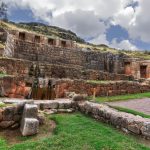
The enclosure is composed of finely carved stone walls, arranged in terraces and decorated with canals, aqueducts, and fountains that guide water from springs hidden in the mountains. Even today, more than five centuries later, these fountains continue to flow with the same purity, as if time had never passed.
For the Incas, this continuity was sacred: water here was not just a resource, it was eternal life.
Water that speaks to the gods
In the Andean worldview, water was much more than a natural element: it was a living deity, a bridge between the earth and the cosmos.
In Tambomachay, every drop that descended through the canals was an offering and, at the same time, a message. The priests and the Inca himself performed purification ceremonies here, libations for Pachamama, and agricultural rituals that ensured the fertility of the fields.
The constant water was a symbol of renewal and abundance, but also of communication: the apus (mountain spirits) spoke through its murmur. Even today, when you stand in front of the twin waterfalls, you feel the water transmitting a whisper, a song that never ceases.
Sacred engineering that defies time
If anything inspires admiration in Tambomachay, it is the precision of its hydraulic engineering.
The Incas mastered the art of channeling invisible springs, building underground aqueducts that still function perfectly. The water not only arrives clean and constant, but also divides into two identical fountains that fall with the same force and clarity.
This seemingly simple detail is a masterpiece of balance and symmetry, reflecting Andean philosophy: duality in harmony. Above and below, life and death, humankind and nature. Everything must coexist in balance, and the water of Tambomachay is a living metaphor for that principle.


The Inca’s Refuge
Tambomachay was also a place of rest. Its name comes from the Quechua words tampu (inn) and mach’ay (resting place). Here, the Inca and his entourage could stop during their tours of the region, breathe the pure mountain air, and listen to the water as if listening to advice from the gods.
Imagine for a moment the scene: the Inca sitting on the terraces, watching the water flow perfectly, unchangingly, while the priests offered coca leaves to Pachamama. It wasn’t just any rest: it was a ritual of connection with nature.


The Power of Simplicity
The magic of Tambomachay lies in its lack of ostentation. There are no imposing walls or monumental sculptures: there is silence, stone, and water.
And yet, that silence speaks. The precisely carved stones hold memory. The water that runs steadily reminds us that life flows even when everything else changes.
Visiting Tambomachay is understanding that, for the Incas, true greatness lay in the simple yet eternal.
Tips for your visit:
📍 Location
Just 8 km from the city of Cusco, on the route to the Sacred Valley. You can get there by taxi, on foot, or as part of a tour.
🎟️ Entrance fee
Included in the Cusco Tourist Ticket.
🕒 Recommended time
Between 30 and 45 minutes. Although it’s small, its atmosphere deserves to be enjoyed slowly.
🌞 Useful tips
Go early in the morning or at dusk to experience the tranquility of the place.
Wear light clothing and a jacket: the weather in the area changes quickly.
Combine it with Qenqo and Puca Pucara, which are on the same archaeological route.
Take a few minutes in silence in front of the fountains: the experience is transformed when you let the water speak to you.
The Song That Never Sleeps
Tambomachay is not just archaeology. It is a living temple, a sanctuary where nature remains the protagonist.
The water that flows here never stops, never remains silent, never sleeps. It is the same water that accompanied the Incas in their rituals, the same water that today accompanies the curious traveler who stops to listen.
Anyone who sits before its waterfalls understands that the Andes’ most valuable heritage was not gold or stone, but a profound respect for the sacredness of life. And Tambomachay is its best example: the eternal spring where the water never sleeps.