
High on the Andean plateau, nearly 4,000 meters above sea level, where the air is thin and the horizon stretches with austere clarity, lie the monumental remains of Tiawanaku. Winds sweep across the Altiplano with little resistance. The sky feels closer here — vast, unfiltered, almost architectural in its presence.
It was in this environment — severe, demanding, and seemingly inhospitable — that one of the most sophisticated pre-Columbian civilizations of South America emerged.
Long before the Inca Empire consolidated political power across the Andes, before Cusco became imperial capital, before Machu Picchu was conceived among the clouds, Tiawanaku had already developed urban planning, monumental architecture, hydraulic engineering, astronomical alignment, and a far-reaching ideological network.
Tiawanaku was not a precursor in the sense of an incomplete experiment.
It was a fully realized civilizational project.

Summary
The Altiplano: A Harsh Environment as Sacred Center
Modern observers often interpret the Altiplano as peripheral — remote, elevated, climatically extreme. But for Tiawanaku, this region was not marginal. It was central.
The proximity to Lake Titicaca is fundamental to understanding this. In Andean cosmology, Titicaca is not merely a lake; it is a place of origin. Myths describe it as the birthplace of the sun and of foundational beings who shaped humanity.
To build near Titicaca was to situate authority at the cosmic source.
Tiawanaku did not randomly occupy territory. It established itself at the symbolic axis of creation.
In doing so, geography became theology.

Urban Design as Cosmological Blueprint
Tiawanaku was not an accidental accumulation of structures. Its ceremonial core demonstrates deliberate planning: sunken plazas, raised platforms, monolithic gateways, aligned corridors, and controlled spatial sequences.
Movement through the site would not have been casual. It was structured.
Approach, elevation, enclosure — each architectural gesture guided ritual experience. The city was not simply inhabited. It was performed.
Architecture became choreography.
The monumental quality of its structures is striking. Megalithic blocks weighing multiple tons were quarried, transported across considerable distances, and assembled with extraordinary precision. Stone joints fit tightly. Surfaces were polished. Right angles were executed with careful calculation.
This was not primitive improvisation.
It was engineered intentionality.

The Gateway of the Sun: Time Encoded in Stone
Among Tiawanaku’s most iconic monuments stands the Gateway of the Sun — a single monolithic block carved from andesite. At its center appears a staff-bearing deity, often identified as a solar or creator figure, surrounded by rows of smaller winged attendants arranged in strict symmetry.
This relief is not ornamental excess.
Its structured repetition suggests calendar logic. Many scholars propose that the gateway encodes solar cycles and agricultural timing, functioning as a visual representation of cosmic rhythm.
If so, then the gateway served as both symbol and instrument.
Time was not abstract in Tiawanaku.
It was measured, monumentalized, and stabilized in stone.
In a landscape where seasonal variation could determine survival, astronomical precision was both practical necessity and political authority.
To interpret the sky was to command legitimacy.
Akapana: Constructing the Sacred Mountain
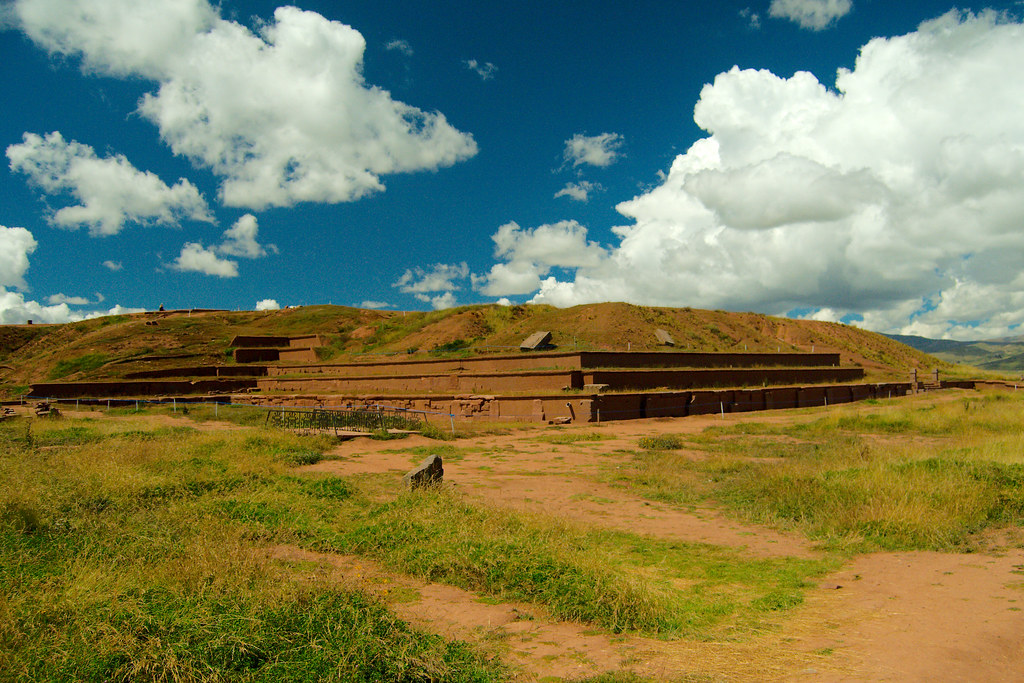
The Akapana pyramid dominates the ceremonial complex. More than a stepped platform, it is an artificial mountain — an architectural reproduction of the sacred Andean peak.
In Andean cosmology, mountains (Apus) are living beings, intermediaries between worlds. By constructing a mountain, Tiawanaku did not imitate nature. It replicated cosmic structure.
The pyramid incorporated an advanced hydraulic system. Rainwater was channeled internally, flowing through carefully engineered conduits before emerging at designated points.
Water descending from the summit reinforced symbolic meaning:
Sky → Rain → Mountain → Earth.
The flow was cosmological as much as hydraulic.
Akapana was not merely built upward.
It was built to connect realms.
Kalasasaya: Observatory and Political Theater
The Kalasasaya platform reveals further sophistication. Its orientation aligns with solstitial sunrise and sunset points, demonstrating careful astronomical observation.
These alignments were not accidental aesthetic choices. They anchored ritual to celestial cycles. During solstices, sunlight would interact with architectural features in precise ways, transforming the space into a stage where cosmic order became visible.
Astronomy here was not detached science.
It was statecraft.
By synchronizing architecture with celestial movements, Tiawanaku embedded its authority within the structure of the universe itself.
Political legitimacy became cosmic alignment.
Agricultural Mastery: Engineering Survival
Perhaps one of Tiawanaku’s most remarkable achievements lies beyond its ceremonial center: its agricultural innovation.
The Altiplano’s climate presents severe challenges — frost, irregular rainfall, temperature fluctuations. Yet Tiawanaku developed a system of raised agricultural fields known as “waru waru.”
These elevated planting platforms were surrounded by water channels that absorbed solar heat during the day and released it at night, mitigating frost damage. The system created microclimates, increasing productivity and stabilizing yields.
Agriculture was not left to environmental chance.
It was technologically mediated.
Such innovation required coordinated labor, administrative oversight, and social cohesion.
Tiawanaku’s power was rooted not only in ideology, but in sustainable subsistence systems.

Iconography and Ideological Expansion
The monolithic sculptures of Tiawanaku depict stylized anthropomorphic figures holding ritual objects. Their rigid postures and repetitive motifs suggest abstraction rather than portraiture.
These figures represent archetypes, not individuals.
The recurrence of similar iconography across distant regions indicates that Tiawanaku extended influence far beyond its core. Sites in southern Peru, northern Chile, and northwest Argentina show stylistic and cultural connections.
This was not conquest in the imperial military sense.
It was ideological diffusion.
Tiawanaku’s worldview radiated outward, creating a network of shared symbolism and ritual practice.
Political Structure Without Written Record
Unlike later civilizations with written chronicles, Tiawanaku left no decipherable textual archive. Its administrative structure must be inferred from material remains.
The scale of construction implies centralized coordination. Quarrying, transporting, and assembling massive stone blocks required planning, workforce organization, and leadership.
Ceremonial spaces imply stratification. Access was likely regulated. Ritual authority probably intertwined with political governance.
Tiawanaku appears to have operated under a theocratic model, where religious leadership and political power were inseparable.
Authority derived from cosmological mediation.
Crisis, Climate, and Decline
By around 1000 CE, Tiawanaku began to decline. Paleoclimatic studies suggest prolonged drought may have disrupted agricultural systems. Without stable production, social cohesion could have weakened.
Decline, however, was gradual.
The ceremonial core was eventually abandoned, but the cultural legacy persisted.
Later Andean societies — including the Inca — recognized Tiawanaku as an ancestral site. Some traditions identified it as a place of primordial creation.
Even in abandonment, it retained sacred significance.
Civilizations may collapse.
Symbols endure.

Tiawanaku and the Question of Civilization
Tiawanaku challenges simplistic definitions of advanced society. It lacked alphabetic writing, yet demonstrated astronomical precision. It operated without steel tools, yet executed megalithic engineering of remarkable accuracy.
Its sophistication lay not in technological spectacle alone, but in systemic integration.
Landscape, agriculture, cosmology, and architecture functioned as interdependent elements.
The city was a three-dimensional cosmogram — a diagram of the universe built at human scale.
The Experience of Standing There
Today, walking through Tiawanaku is an encounter with structural thought. The wind moves across fractured stone. The Gateway of the Sun stands against the horizon. Akapana rises, partially restored yet still imposing.
The site does not overwhelm through lush scenery or dramatic elevation changes.
It commands through proportion.
Through geometry.
Through endurance.
It speaks of a civilization that understood permanence — not as static preservation, but as alignment with natural cycles.

Tiawanaku: A Civilization of Alignment
Ultimately, Tiawanaku’s greatest achievement may not be its monuments, but its integration.
It aligned:
Earth with sky.
Agriculture with climate.
Architecture with astronomy.
Power with cosmology.
It did not seek to dominate nature in opposition.
It sought to inscribe itself within natural order.
In the cold clarity of the Altiplano, where the sky feels infinite and the wind erodes without haste, Tiawanaku remains.
Not merely as ruin.
But as evidence that long before empires rose and fell, there existed a society capable of transforming stone into ideology, landscape into cosmology, and architecture into a durable map of the universe.
And even in silence, it continues to articulate that vision.