
🌄✨ A Place Where Myth and History Intertwine
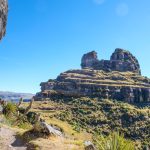
High in the Andes above Cusco, at over 4,000 meters above sea level, stands Waqrapukara, a fortress-temple that is striking not only for its Inca architecture, but also for the mountain’s unique shape: two enormous rocks that resemble bull horns defying the sky.

-Waqra = horn 🐂
-Pukara = fortress 🛡️
Although many know it as “the fortress with horns,” it was actually much more than a military bastion: a sacred space for the ancient Qanchi and, later, for the Incas.
📜 The history behind the stones
Before the arrival of the Incas, the territory where Waqrapukara is located was inhabited by the Qanchi, a warrior people who fiercely resisted the expansion of the Tahuantinsuyu. According to chronicles, the Inca Huayna Capac conquered the Qanchi, and Waqrapukara became a ritual center where the apus, the guardian spirits of the mountains, were worshipped.
The perfectly carved stone walls, ceremonial plazas, and trapezoidal niches demonstrate the Inca style, but the way everything merges with the bedrock speaks of a profound respect for the mountain. Here, it was not just about dominating nature, but about coexisting with it.
In the center of the complex, there are terraces, enclosures, viewpoints, and ceremonial platforms that were likely used in ritual offerings to the Andean gods, praying for fertility for the earth and balance in the cosmos.


🐂 The Myth of the Stone Bull
Oral tradition tells that the Waqrapukara Mountains are the incarnation of a petrified sacred bull. This bull, guardian of the Qanchi shepherds, challenged the sun in a cosmic battle and was forever transformed into rock, watching over the valleys and canyons from above.
The wind that blows strongly in the heights seems to imitate a moo. For this reason, many travelers feel that the place has an animal echo, an ancient roar that lives on in the stone.
🚩 The Experience of Getting There
Getting to Waqrapukara is not just about tourism: it’s a ritual of travel.
There are several routes:
Santa Lucía Route (the most accessible): about 2 to 3 hours of hiking. Ideal for those seeking a balance between adventure and contemplation.
Pitumarca Route (the most challenging): up to 8 hours of trekking, surrounded by mountains, canyons, and lagoons. Perfect for adventurers who want to experience absolute silence.
Spiritual route: some travelers arrive accompanied by paqos (Andean priests) to participate in ceremonies offering to Pachamama.
Upon arrival, the first sensation is one of smallness: the fortress resembles a natural amphitheater, with walls that open toward the abyss, as if it were a portal to the unknown.

🌌 What you will feel at Waqrapukara
Absolute silence, broken only by the wind.
The vertigo of the landscape, with deep canyons that remind us that the mountain also knows how to command respect.
The energy of the place, difficult to describe, but easy to feel: many claim it is a place charged with spiritual magnetism.
When the sun sets, the shadows lengthen their “horns,” and Waqrapukara resembles an ancestral guardian gazing at the horizon.
🎒 Unique Travel Tips
Be physically prepared: the altitude can be detrimental if you’re not acclimatized.
Bring coca or muña leaves: they’ll help you breathe better, and you can also offer them at the natural altars.
Climb in silence for a few minutes: many locals say that only then does the place “reveal its message.”
Stay until sunset: the spectacle of light and shadows is hypnotic.
🌟 Why is Waqrapukara different from Machu Picchu?
Unlike the more famous Inca citadel, Waqrapukara still offers the solitude and mystery of a little-explored place. Here, there are no large crowds, no lines, no noise: just you, the wind, and the mountain.
Waqrapukara is not just an archaeological destination: it’s a portal to the past, a stone sanctuary that combines history, myth, and spirituality, awaiting travelers looking for more than just a photo.
👉 In this blog, I want the reader not only to read, but to imagine:
Would you choose the difficult route or the short one?
Would you dare to spend a night camping under the stars?
Would you offer coca leaves to the apu or just contemplate in silence?